

 EN
EN  DE
DE  FR
FR 





pH ProAqua 7.4–9.0 Test
- save 2%
- save 4%
- save 6%
To determine the pH level in the pond
 Delivery time: 1-2 working days
-
CHF 19.50
Value pack offer
pH test: 7.4–9.0, 80 measurements
plus shipping costs (free from CHF 69.00.-) Saving package available
Up to 6% cheaper
items selected (% discount applied)
from 2 pcs. 2% discountfrom 3 pcs. 4% discountfrom 4 pcs. 6% discount and free shippingRecommended
Saving package available
Up to 6% cheaper
items selected (% discount applied)
from 2 pcs. 2% discountfrom 3 pcs. 4% discountfrom 4 pcs. 6% discount and free shippingRecommended


-
For fish

JBL pH ProAqua 7.4–9.0 Test
A healthy pond with near-natural conditions
The correct water parameters in a pond depend on the fish population and the plants present. Even if the water looks clear, it may still be contaminated. Poor water parameters can lead to diseases or algae growth in the pond. For a healthy pond with near-natural conditions, regular monitoring and adjustment of water parameters are important.
For every water analysis, JBL offers water tests in the form of rapid tests or color-change tests. These determine a specific value or multiple values simultaneously. With these water tests, algae problems can be detected and negative nitrate, nitrite, potassium, magnesium levels, etc., can be identified.
Why test:
Maintaining a suitable pH level as consistently as possible is an important prerequisite for the well-being of all aquatic organisms. Sudden fluctuations, in particular, should be avoided at all costs. In addition, many substances dissolved in water are subject to pH-dependent changes.
For marine organisms, pH levels around 8.2 are considered optimal. Especially in saltwater aquariums with invertebrates, the consumption of calcium bicarbonate can cause the pH level (and carbonate hardness) to drop if a regular supply is not ensured. When caring for fish from slightly alkaline freshwater bodies, such as Lake Malawi and Lake Tanganyika, values around 8–8.5 are recommended.
For koi and other species, pH values between 7.5 and 8.5 are considered optimal; in garden ponds, but also in freshwater aquariums, a CO₂ deficiency can cause algae in particular to consume the bicarbonate in the water through rapid assimilation during photosynthesis (biogenic decalcification), thereby driving the pH level to dangerous heights for fish (above 10).
| Water Type | Recommended nitrite levels |
|---|---|
| Freshwater aquarium (community aquarium) | 6.5–7.5 |
| Malawi and Lake Tanganyika aquariums | 7.8–9.2 |
| Planted aquariums with few fish (aquascaping) | 6.0–7.0 |
| Marine aquariums | 7.9–8.5 |
| Ponds | 7.5–8.5 |
Procedure:
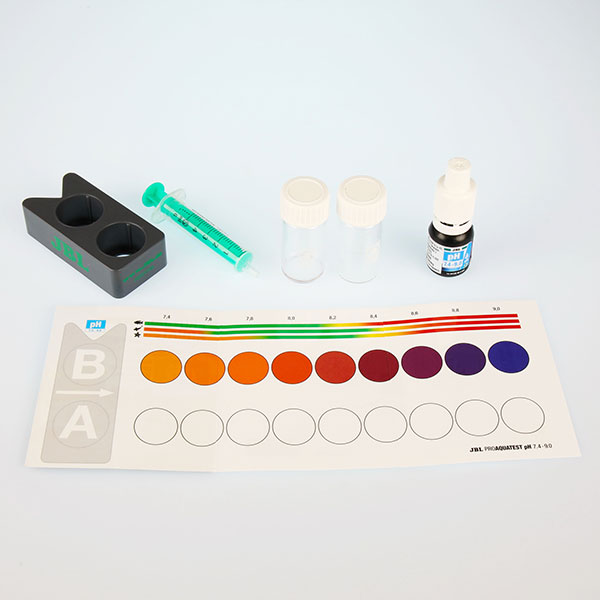
- Rinse both test tubes several times with the water to be tested.
- Using the enclosed syringe, fill both test tubes with 5 ml of sample water each.
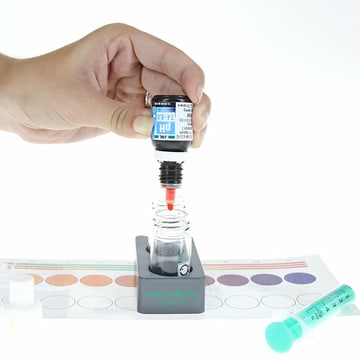
- Add 4 drops of Reagent 7.4–9.0 to one of the test tubes, mix by swirling, and let stand for 3 minutes.
- Place both test tubes in the gray comparator block: the tube with the added reagent at the smooth end of the comparator block, the tube with untreated sample water (blank sample) at the notched end.
- Place the comparator block with the two test tubes on the color chart so that the notch faces the values, and slide it along the color chart until the color of the sample with added reagent matches the color below the blank sample as closely as possible.
- Read the pH value at the notch on the comparator.
Correction of deviating values:
Too low: Add JBL pH-Risers. If using a CO₂ fertilization system in freshwater, reduce the CO₂ supply.
Too high: Lower the pH value by adding JBL pH-Lower or, optionally for freshwater aquariums, by supplying CO₂ with the JBL ProFlora CO₂ fertilization system.
Use biocides with caution. Always read the label and product information before use.
  |
Hazard statements: H226 Liquid and vapor are flammable. H319 Causes serious eye irritation. P102: Keep out of reach of children. P501a: Dispose of contents/container in accordance with local regulations |
Customer Questions



5.0/5.0
(1 review)
-
Gute Qualität
Verified Online Purchase
Einfache Handhabung

 Verified Online Purchase
 Secure payment
When you buy online, all your data is encrypted using SSL (Secure Socket Layer).
Loyalty points
As a registered customer, you collect loyalty points with every purchase: 500 points = 10 francs.
Fast delivery
Online orders are usually delivered within undefined! (Does not apply to prepayment).


