
 EN
EN  DE
DE  FR
FR The Best Cat Litter – Eight Different Products Tested!
-
 By
Dr. med. vet. Sabina Büttner
By
Dr. med. vet. Sabina Büttner - Feb 14, 2020
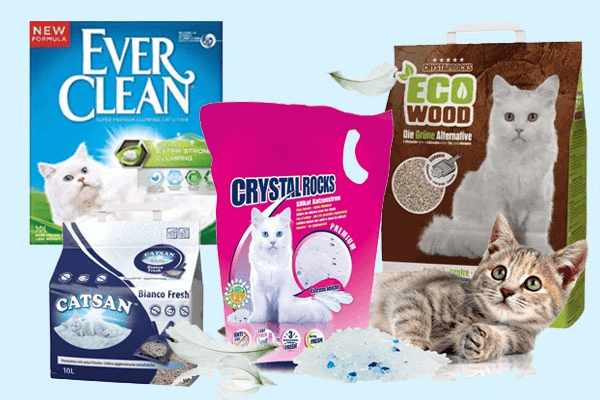
The selection of cat litter is huge – we tested a few of them together with our cats. Here you can find the results.
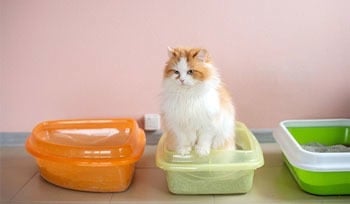
To start with: The best cat litter is the one your cat prefers! Because even the best litter is useless if your cat doesn't like it and therefore stops using it properly. So, if your cat is used to a specific cat litter, don't just abruptly switch to another one. Instead, offer her the new litter in a second litter box and observe how she reacts.
Not only are cats' preferences individually very different, but cat owners also have different requirements for cat litter. We therefore recommend that you try out various products yourself – our assessment can certainly help you in choosing which litter to compare.
Basically, there is cat litter on a plant-based or mineral-based as well as Silica gel litter, which differ greatly in their properties and have specific Benefits and disadvantages.
We tested several cat litter types from all groups. This is not a representative test, but rather our subjective perception. We also set up 2 litter boxes with different litter each and observed which type was preferred by our cats.
The test was conducted with 2 long-haired cats, which must be taken into account, especially when assessing odor development. With a single cat, it would certainly take longer for odor development to become noticeable. The litter boxes were cleaned of feces and clumps at least once a day, and the removed litter was replaced with fresh.
Our assessment criteria were:
- Handling: how heavy is the litter, how easy is it to pour into the litter box, how well can feces or clumps be filtered out with common litter scoops
- Dust formation: how much dust is stirred up when filling the litter box
- Tracking: how much of the litter sticks to paws and coat and is tracked throughout the apartment
- Clumping: do firm clumps form? Can the clumps be removed well without falling apart?
- Odor control: how long does it take, with daily removal of feces and litter clumps, until a urine odor becomes noticeable.
- Cats' preference: which litter is preferred by our cats
Mineral Cat Litter
This classic cat litter consists of clays like bentonite, which are usually clumping and can absorb a lot of liquid. A major disadvantage of this type of litter is its weight! Furthermore, it should be disposed of exclusively with household waste.
In this category, we tested the following 3 litters: Catsan Bianco Fresh, Biokat’s Classic and EverClean Scented Extra Strong Clumping.
All three are naturally heavy to carry. The cardboard box for EverClean is quite thick, but can be easily opened with a tab, making it easy to fill the litter boxes with all three types. Dust development when filling is most pronounced with Catsan, followed by Biokat’s Classic. The EverClean Extra Strong Clumping produces significantly less dust.
EverClean also excels in terms of tracking. It has the finest grain size of the three types, and although it is usually claimed that the larger the grain size, the less the litter is tracked, clearly the least of this litter sticks to our cats' paws.
All three form firm clumps, with those from EverClean being the hardest. In some cases, the clumps of this litter even stick quite firmly to the litter box, so they have to be removed with some effort.
In terms of Odor control, Biokat’s Classic performs the worst. After just one week, the first odor emissions become noticeable, and after 2 weeks, the entire litter box needs to be cleaned. With Catsan, a complete cleaning of the litter box was necessary after approx. 3 weeks, and with EverClean, no strong odor had developed even after a month. The better Odor control is probably due to the fact that both Catsan and EverClean contain activated carbon, which helps to bind unpleasant odors.
Our cats like all three types. They don't specifically prefer any. However, Mineral cat litter is preferred by them over Silica gel or natural fiber litter.
Silica Gel Litter
Having emerged a few years ago, Silica gel litter is particularly popular among those who don't like non-clumping cat litter, although it is also available today as a clumping variant. It is made from quartz sand, which is processed into a highly absorbent granulate. It is non-toxic and, in principle, compostable, although it should be noted that in many municipalities, the disposal of cat feces in green waste is not permitted.
We tested the non-clumping CrystalRocks Premium, as well as the CrystalRocks Plus, which forms clumps.
Both are light, easy to transport, and easy to fill into the litter box. The plastic packaging is probably necessary so that the Silica gel does not absorb Moisture from the environment during storage. Crystal Rocks Plus is a very fine granulate that produces some dust when filling. However, the coarser granulate of Crystal Rock sticks strongly to the long hair on my cats' paws and is thus tracked throughout the entire apartment. With this litter, you also absolutely need a litter scoop with large holes so that the large Silica gel grains can fall through.
The Clumping of CrystalRocks Plus leaves much to be desired. The clumps fall apart easily and are therefore difficult to remove. To ensure that liquid absorption remains constant for a long time, the litter box for both types of litter must be shaken a little daily.
Odor development starts after approx. 1 week for both, and after 2 weeks, we had to replace the entire content for both litters.
Our cats preferred the fine granulate of CrystalRocks Plus over the coarser granulate of Crystal Rocks. In general, however, they prefer cat litter made of clay or natural fibers.
Natural Fiber Cat Litter
The range of Natural Fiber Cat Litter is currently growing. They consist of plant fibers or wood and are therefore easily biodegradable and environmentally friendly. They are actually compostable – but here too, it should be noted that the disposal of litter box waste via green waste collection is prohibited in many municipalities.
We tested the types Cat’s Best Smart Pellets and Crystal Rocks EcoWood made of wood, and AlmoNature Catlitter made of plant fibers.
All three are light and easy to transport. When filling the litter box, it is noticeable that all three types show little or no dust development. They also all three smell very pleasant. The pellets from Cat’s Best are approx. 0.5-1 cm long and are therefore not supposed to stick to the coat of long-haired cats. However, the pellets are so large that they cannot be sieved with a normal litter scoop, which is impractical for cleaning the litter box. AlmoNature Catlitter, on the other hand, is a very fine-grained cat sand.
The Clumping of EcoWood and AlmoNature is very good. The clumps are stable and do not fall apart. With Cat’s Best, initially quite compact clumps are formed, but the longer the litter is in use, the more likely the clumps are to fall apart and can no longer be removed well.
The Odor control of AlmoNature and Cat’s Best is significantly worse than that of EcoWood. After approx. 1 week, a slight odor is noticeable, and after 2 weeks, the entire litter box needs to be cleaned. With EcoWood, the total cleaning can be postponed for a good week longer.
A major disadvantage of all 3 types: the tracking of the litter throughout the apartment. Unfortunately, both the large pellets of Cat’s Best and the fine sand grains of AlmoNature stick to the coat of our cats.
My cats clearly prefer fine-grained litter, so they prefer EcoWood and AlmoNature over Cat’s Best Smart Pellets. In general, however, they still like mineral cat litter the most, probably because they have known it since they were little.
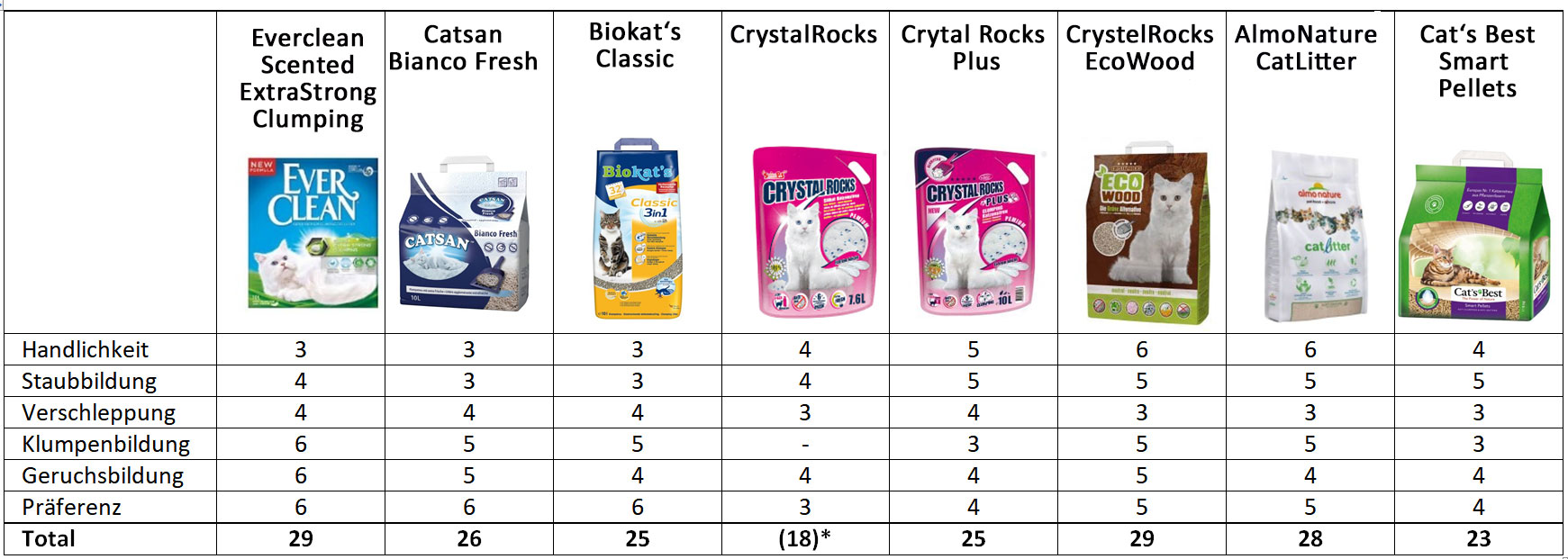
Grading scale: 6= very good 5=good 4=sufficient 3=insufficient
* since Crystal Rocks is a non-clumping litter, the total score cannot be compared with the others
Conclusion of our Cat Litter Test
The EverClean Extra Strong Clumping cat litter and Crystal Rocks EcoWood performed equally well in our test. While we prefer the environmentally friendly and light EcoWoods, our cats give preference to EverClean. We're now alternating!
However, there are still many types of cat litter that we have not yet tested ourselves. If you have already had experience with cat litter from our range, please submit a customer review in our shop and help others find the ideal litter.
Useful information at a glance
Which cat litter is best for my cat?
The best cat litter is the one your cat prefers. Even the highest quality litter is useless if your cat doesn't like it and becomes unclean. If your cat is accustomed to a specific litter, do not switch abruptly; instead, offer the new litter in a second litter box and observe how your cat reacts.
What types of cat litter are there and what are their benefits and drawbacks?
There is plant-based or mineral-based cat litter, as well as silicate litter. Mineral litter, such as bentonite, is clumping and absorbs a lot of moisture, but it is heavy. Silicate litter is lightweight and highly absorbent, but often not clumping. Natural fiber litter is environmentally friendly and biodegradable, but it can be tracked throughout the home.
How can I minimize odor formation with cat litter?
To minimize odor formation, you should clean the litter box of feces and clumps at least once daily and replace the removed litter with fresh litter. Litter with activated carbon, such as EverClean Extra Strong Clumping, can help to bind unpleasant odors more effectively.
How do I dispose of cat litter correctly?
Mineral cat litter should only be disposed of with household waste. Silicate and natural fiber litter are in principle compostable, but the disposal of cat feces in green waste is not permitted in many municipalities. Inform yourself about local disposal guidelines.
How can I test different types of cat litter without stressing my cat?
To avoid stress, do not switch the litter abruptly. Set up a second litter box with the new litter and observe if your cat accepts it. This way, you can find out which litter your cat prefers without unsettling her.