
 EN
EN  DE
DE  FR
FR Understanding Dog and Cat Food Labels
-
 By
med. vet. Bianca Michoud-Valente
By
med. vet. Bianca Michoud-Valente - Apr 14, 2023
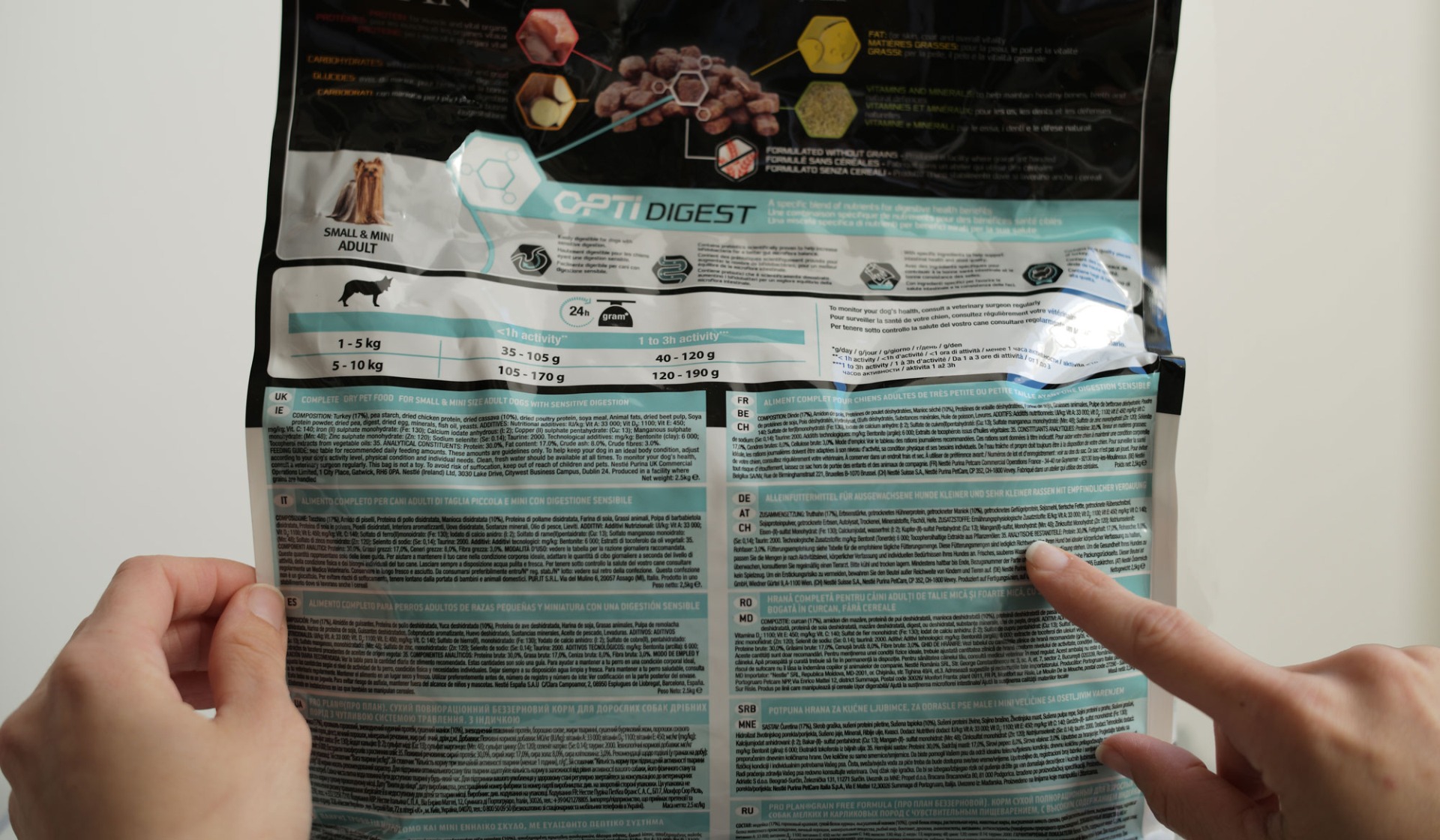
Commercial dog and cat food is available in a wide variety of brands, textures, and flavors, each promising different nutritional Benefits. It can be challenging to navigate this jungle of offerings and correctly understand the information on pet food packaging. In this article, we will show you how to decipher the most important elements of dog and cat food labels, so you can make the best choice for your beloved pet.
The information on cat and dog food labels or packaging is crucial for pet owners who care about the health and well-being of their animals. This information helps you understand exactly what is contained in the food and to select the food that is best suited for your pet in terms of composition, quality, and nutritional value. Labels contain information about ingredients, additives, the percentage of nutrients, and other components important for your pet's diet. Correctly understanding these details is therefore essential to assess the nutritional quality of products.
If you, as a pet owner, can correctly interpret the food information, you will also be able to choose a balanced and high-quality diet for your furry friend that meets their individual nutritional needs based on age, weight, and activity level. The information on the label can also help identify ingredients that may potentially trigger allergies or be problematic for certain animals with existing allergies or intolerances. This way, foods containing these ingredients can be avoided. In summary, the information on the labels enables an informed decision for dog and cat food, thus contributing to your pet's health.
What does the law say?
The FEDIAF (European Pet Food Industry Federation) is the European organization that sets the guidelines for the production and marketing of pet food. EU law mandates the following labeling requirements for dog and cat food:
- Indication of the name and address of the manufacturer or distributor of the feed.
- Indication of the food category: "Complete food" or "complementary food" as defined by FEDIAF.
- List of ingredients: The list of ingredients, also called "composition," must be stated in descending order of their weight, starting with the ingredient present in the largest proportion in the feed.
- Analytical constituents: The label must state the content of essential nutrients, which for Complete food are Crude protein, Crude fat, Crude fiber, and Crude ash. These values are expressed as percentages or in grams per kilogram. They vary depending on the type of food (Complete food, complementary food, minerals, dry food, wet food).
- Feeding recommendation: The label must specify the recommended daily amount of food that should be fed, depending on the dog's or cat's weight and age.
- Minimum shelf life (MHD): The label should indicate the minimum shelf life of the food, which assures you that nutrients like vitamins are guaranteed to be present in the specified amount in the product until this date. However, it is generally not harmful to use a feed after this date if it has been stored properly and is dry food (kibble).
- Batch number: The batch number must be indicated on the label so that the product can be identified in case of quality or safety issues.
Furthermore, EU law prohibits the use of certain ingredients in the production of feed, such as hormones, antibiotics, and GMOs. It is important to note that labeling requirements may vary slightly in individual European Union countries. In Switzerland, the production and sale of pet food are regulated by food law. Manufacturers must adhere to strict standards regarding ingredients, hygiene, and labeling. Regular checks are carried out to ensure that producers comply with these standards.
Complete food or complementary food?
Complete food is usually available in the form of kibble or wet food and is formulated to meet the specific nutritional needs of the respective animal species. If a food is labeled as "Complete food," it means that the food contains all important nutrients in sufficient quantities to cover the daily nutritional requirements of a dog or cat. A Complete food is designed to be the sole source of nutrition for the animal and does not need to be supplemented with other feeds or food supplements.
In contrast, a "complementary food" is a feed that does not contain all the nutrients necessary for a balanced diet and should absolutely only be used as a supplement to a Complete food to support the supply of additional nutrients or to meet special needs.
For example, dog snacks are complementary food as they cannot provide all the nutrients required for a balanced diet and should therefore not be used as the main food source.
It is therefore recommended to carefully read the label of every food to understand its composition and recommended use.
Composition and Ingredients
Most commercial feeds are formulated using multiple ingredients. The ingredients are listed under the category "Composition." When deciphering food labels, it is helpful to understand the food's composition from the different types of ingredients it may contain. Ingredients are listed in descending order, corresponding to their proportion in the final product in grams or kilograms: The ingredients used in the largest quantities are listed first, while ingredients used in small amounts, making up only a small part of the final product, are listed last.
The ingredients of dog and cat food can generally include: meat, grains or other carbohydrate sources (potatoes, legumes), vegetables, fruits, oils, vitamins, minerals, and feed additives to meet the animal's nutritional needs.
When protein sources are specified (poultry, beef, lamb, soy...), you can better control what type of protein your pet will eat, which is necessary for animals with allergies. Sometimes the manufacturer specifies a certain meat content, e.g., "Chicken 15%." Such a declaration is not legally required, but if made by the manufacturer, it informs about the minimum content of the named ingredient, and its presence must therefore be guaranteed.
Among the ingredients, you will often find animal by-products, also referred to as animal derivatives. These are general terms describing ingredients of animal origin (with the exception of dairy products, for which there is a separate category) that arise as by-products in human food production. These are parts of carcasses that are not normally consumed by humans. This simply refers to offal (liver, heart, lungs, kidneys, tripe...). Some animal by-products can therefore be of high quality and provide the animal with important nutrients such as proteins, vitamins, and minerals.
Cat food sometimes has small amounts of sugar added to improve its appearance and taste, and thus its palatability. However, cats do not need sugar in their diet, and their natural food normally contains no sugar. Read our guide article on this topic (Sugar in Cat Food).
All in all, the ingredients a food consists of can give you an idea of its quality and digestibility. The ingredient list also provides important information for selecting a food in cases of food allergies, dietary sensitivities, and specific pet preferences.
Analytical constituents
The Analytical constituents refer to the content of nutrients and other components (vitamins, minerals, trace elements, fatty acids, ...) in food. These nutrients are indicated as percentages and determined using standardized analytical methods.
The nutritional role of the Analytical constituents is crucial. Proteins (Crude protein) are needed for growth, tissue repair, muscle mass maintenance, and biochemical reactions. Fats (Crude fat) provide energy, Dietary fibres (Crude fiber) aid digestion, minerals (Crude ash) are responsible for building tissues and bones and for the smooth functioning of a variety of metabolic processes. Water (Moisture) is needed to supply the animal with fluids. The nutritional needs of dogs and cats vary depending on age, breed, activity level, and health status. Commercial food must therefore be formulated according to these specific needs.
According to EU regulations, the following essential nutrients must be declared on the label of a Complete food for dogs and cats:
- Crude protein
- Crude fat
- Crude fiber
- Crude ash
- (Moisture, if higher than 14%)
In addition to these nutrients, manufacturers can also declare other nutrients or components on the label, such as calcium, phosphorus, sodium, trace elements, or vitamins.
However, these nutrients are not the only ones important in the diet of dogs and cats. Other nutrients such as essential amino acids, essential fatty acids, and micronutrients are also required for a balanced diet. Manufacturers can include these nutrients in the list of Analytical constituents on the label or mention them elsewhere in the nutritional information accompanying the product.
It is important to note that the Analytical constituents do not provide information about the quality or digestibility of the ingredients used in production, but only about their nutrient content. Therefore, it is essential to read the ingredient list carefully.
Additives
Additives are ingredients added to dog and cat food to improve taste, appearance, texture, shelf life, or nutrient content, or to provide other Benefits.
Natural additives come from sources such as plants, vegetables, fruits, or other animals.
Artificial additives, on the other hand, are synthetically produced substances. Some of the artificial additives commonly used in pet food include colorants, flavorings, preservatives, and sweeteners.
All additives used in pet food must be approved by the relevant regulatory authorities and meet food safety standards. Manufacturers are obliged to state all additives used, by name and quantity, on the pet food label.
Furthermore, additives can also be added for purely nutritional reasons. Here are some examples of additives that can be beneficial for animal health:
Vitamins and Minerals: Commercial food is often enriched with vitamins and minerals to ensure that dogs and cats receive all the nutrients they need to stay healthy. Vitamins and minerals can also be added to compensate for nutrient deficiencies or to meet the specific needs of animals depending on their age, size, breed, activity level, or health status. Vitamin E (alpha-tocopherol) is frequently used for its antioxidant effect, which improves the food's shelf life.
Fatty Acids: Omega-3 and Omega-6 fatty acids are essential for a cat's diet. They should therefore be added to commercial food if they are not already present in the ingredients used. In addition, Omega-3 and Omega-6 fatty acids are also frequently added to dog food, as they contribute to maintaining healthy skin and coat, as well as healthy cardiovascular, joint, and brain function. Fatty acids can also help inhibit inflammation and support the immune system.
Dietary fibres: Dietary fibres are added to improve digestion and gut health. Dietary fibres can also help with weight management by promoting satiety.
Probiotics: Probiotics are beneficial bacteria that help balance the gut flora and strengthen the immune system.
In short, additives primarily contribute to providing a balanced and complete diet and improving its palatability and shelf life.
Nutritional Claims
A nutritional claim is a declaration on the packaging of a feed that provides information about a specific nutritional property. Typically, it also indicates the presence or absence of certain nutrients or ingredients. Nutritional claims are often used to highlight the health Benefits of a product for the animal, such as reducing plaque, promoting digestive health, supporting the immune system, etc. However, no health claims may be made!
These claims can be expressed in various ways, e.g., "rich in protein," "grain-free," "high in fiber," "low fat," etc. The claims can also be expressed in other ways. To be approved, nutritional claims must comply with the strict regulatory standards set by the European Food Safety Authority (EFSA) and the European Pet Food Industry Federation (FEDIAF).
Veterinary diet food is a separate category of feed. These are specially formulated feeds that meet the particular nutritional needs of animals with specific health problems. These feeds are prescribed by a veterinarian and must be used as part of an individual medical treatment.
Nutritional claims on dietary feeds for animals are also regulated by EU law. Their regulation is stricter. They may only be used if their effect has been scientifically proven and they have been approved by the competent authorities. Therefore, it is important to consult a veterinarian to determine your pet's specific nutrient requirements before choosing a Veterinary diet food.
Nutritional claims can be helpful in assisting pet owners in selecting foods for their pets that are tailored to the animal's nutritional needs.
Daily Feeding Recommendations
Feeding recommendations on feed labels or packaging are indications of the recommended daily amounts that an animal should consume depending on its weight and activity level. These recommendations are often given in grams and can vary depending on the brand and type of food. It is important to note that these recommendations are not rigid rules, and every animal is different and has specific nutritional needs. Therefore, it is sometimes necessary to adjust the amount of food given, deviating from the instructions, to suit the animal's metabolism and physical condition.
In conclusion, while deciphering dog and cat food labels may seem complicated at first glance, it is an important step to ensure that you are providing your pet with appropriate and high-quality nutrition. By understanding the various elements on the label (ingredients, Analytical constituents, nutritional claims, feeding recommendations), you can make more informed decisions about your pet's diet. It is also important to remember that European and Swiss regulations for pet food labeling are in place to protect consumers and their animals, and nutritional claims should only be used with caution.
Source : FEDIAF, «Code of Good Labelling Practice for Pet Food», 2018
Useful information at a glance
How can I correctly interpret the information on dog and cat food labels?
The information on dog and cat food labels is crucial for assessing the quality and suitability of the food for your pet. Pay attention to the composition, which is listed in descending order of ingredients by weight. The analytical constituents such as Crude protein, crude fat, Crude fiber, and Crude ash provide information about the nutrient content. Additives and nutrition-related information can also provide important insights. It is important to read the labels carefully to make an informed decision.
What is the difference between Complete food and complementary food?
A Complete food is formulated to meet the entire nutritional needs of a dog or cat and can serve as the sole source of nutrition. Complementary food, on the other hand, does not contain all necessary nutrients and should only be fed in addition to a Complete food to meet specific needs or provide additional nutrients.
What role do the analytical constituents play on the label?
The analytical constituents indicate the content of important nutrients such as Crude protein, crude fat, Crude fiber, and Crude ash. These values are crucial to ensure that the food meets your pet's nutritional needs. They help assess the quality of the food but do not provide information about the digestibility of the ingredients.
Why are additives included in dog and cat food?
Additives are included to improve the taste, shelf life, and nutrient content of the food. They can be natural or artificial in origin and must be approved by the relevant regulatory authorities. Common additives include vitamins, minerals, fatty acids, and probiotics, which can contribute to your pet's health and well-being.
How can I use the feeding recommendations on the label?
The feeding recommendations indicate how much food your pet should receive daily, depending on their weight and activity level. These recommendations are guidelines and can be adjusted according to your animal's individual needs. It is important to consider your pet's weight and physical condition and to consult a veterinarian if necessary.