
 EN
EN  DE
DE  FR
FR How Does an Elimination Diet Work for Allergy Diagnosis in Dogs and Cats?
-
 By
Dr. med. vet. Sabina Büttner
By
Dr. med. vet. Sabina Büttner - Aug 16, 2021

Is your dog constantly licking its paws? Does your cat have chronic diarrhea? Do vet examinations find no cause? Now it's time to conduct an elimination diet to clarify a Food allergy. Here are the most important principles!
When should an elimination diet be performed?
An elimination diet, also called an exclusion diet, is always indicated when there is suspicion that a dog or cat cannot tolerate certain foods. Such suspicion arises when an animal suffers from itching, skin or ear infections, constant diarrhea, or frequent vomiting, and all other causes for such symptoms could be ruled out in comprehensive veterinary examinations.
Is a blood allergy test not simpler and better than an elimination diet for diagnosing Food allergies?
A blood allergy test can search for antibodies against food components. Antibodies of classes IgE and IgG are determined. However, the results of such examinations have little clinical relevance. This means that even animals without allergy symptoms can react positively in the blood test, and there are animals suffering from an allergy where no antibodies are found, thus showing a negative test result.
However, a blood allergy test can help find a suitable elimination diet. If no antibodies against a specific food are found in the blood (reaction class 0/0), this means that this food is suitable for performing an elimination diet in 4 out of 5 cases.
Allergy tests are therefore suitable for selecting ingredients for a home-cooked elimination diet or a suitable commercial allergy diet. However, the allergy test alone is not sufficient for diagnosis.
What is the goal of an elimination diet?
The goal of an elimination diet is to avoid allergy-triggering foods and thereby treat the clinical symptoms. The animal is fed exclusively a specific protein and a carbohydrate for at least 8 weeks, with which it ideally has never had contact before. If the symptoms subside with such feeding and reappear after a provocation with the old feeding, then the diagnosis of Food allergy is confirmed.
What is most important when performing an elimination diet?
The most important thing during an elimination diet is that your pet has absolutely no access to other food. This means:
- no chew bones or other chews
- no "normal" treats
- no flavored tablets (e.g., dewormers), no gelatin capsules
- no complementary food
- no food from other pets
- no dental care products with meat flavor
- no table scraps or crumbs from the floor
- no access to the dishwasher
- no access to litter boxes for dogs
If your pet relies on medication or food supplements for medical reasons, please discuss with your veterinarian whether you should continue to give them or not. Please do not discontinue medication on your own!
In multi-cat households, it is easiest if all cats receive the elimination diet. If cats have unsupervised outdoor access, it may be necessary to inform neighbors that they should not put out food outside. Children, friends, and relatives should be precisely instructed that the animal must not be given any unwanted food. If your dog tends to gobble up everything edible lightning-fast during walks, the only solution is often to put a muzzle on him during walks while on the elimination diet.
Sometimes, despite all precautions, ‘accidents’ are unavoidable. It is therefore advisable to keep an allergy diary during the elimination diet, in which unwanted food intake and allergy symptoms are recorded daily.
How to find the right elimination diet?
To find a suitable elimination diet, all types of food, treats, chews, and additives that an animal has already eaten in its life must be listed. Subsequently, a food is sought that contains a protein source and a carbohydrate source that the animal has never eaten before. An elimination diet can be performed either with a commercial Veterinary diet food or with home-prepared meals.
Elimination diets with special protein and carbohydrate sources
Commercial elimination diets contain only one selected protein and carbohydrate source, which are rarely used in dog or cat food and therefore rarely trigger allergies. Since exotic meat and carbohydrate sources are increasingly found in normal dog and cat food today, the selection for performing such an elimination diet is becoming smaller and smaller. It is also important to ensure that only one type of meat and only one starch supplier is actually used in the food. The ingredient list must therefore be carefully studied.
Hydrolyzed Allergy Diets
In hydrolyzed diets, all contained proteins are broken down into such small particles (hydrolyzed) that they are no longer recognized by the immune system and thus cannot trigger an allergic reaction. All other components of such foods are highly purified so that no traces of protein are contained therein. These foods are particularly suitable for animals whose entire feeding history cannot be ascertained (e.g., because they were adopted from a shelter) or when no suitable food with a selected protein and carbohydrate source is available.
Since even the smallest traces of allergy-triggering substances can prevent allergy symptoms from subsiding, it is important for commercial allergy foods that no contamination with proteins or carbohydrates from other sources occurs during manufacturing. To completely rule this out, such foods must be produced in special production facilities. Such separate production is usually not given for ‘ordinary’ pet food. Therefore, for an elimination diet, a Veterinary diet food should always be used, where the risk of contamination is significantly smaller.
Home-Prepared Elimination Diets
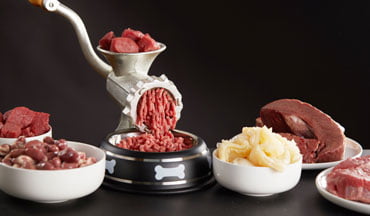
It is also possible to prepare the food for the animal yourself. You will then know exactly what is in the food and can avoid contamination yourself. Time and again, there are dogs and cats that become symptom-free only with a home-prepared allergy diet.
One type of meat (e.g., horse, kangaroo, goat, pork, or rabbit) is mixed with one type of carbohydrate (e.g., peas, sweet potatoes, pumpkin, or parsnip). Ask your veterinarian for a suitable recipe and observe the following during preparation:
- Use high-quality meat and no scraps or meat waste that contain a lot of connective tissue and are therefore difficult to digest.
- When preparing, ensure that the ingredients do not come into contact with other foods.
- The meat should, if possible, be cooked or fried, as this reduces antigenicity and improves hygiene.
- The carbohydrates should be cooked very soft so that they are easier for your pet to digest.
Such home-prepared rations are not balanced. Nevertheless, no food additives should be given during the 6-8 week elimination diet. Only when a home-prepared allergy diet is given long-term must the necessary vitamin and mineral supplements be gradually added. For this, it is best to have an individual ration calculation prepared by a specialized veterinarian.
How long does it take for symptoms to disappear?
Allergy-related digestive problems usually improve within the first 2 weeks. Itching and other skin symptoms significantly decrease within the first 2 to 3 weeks. However, with stubborn skin inflammations, it can take up to 12 weeks for the skin to fully calm down and regenerate. The strict elimination diet should in any case be maintained for 6 to 8 weeks.
What can I give my pet as a reward?
Many pet owners want to be able to reward their pet even during an elimination diet. While there are some snacks made from hydrolyzed proteins today, this type of reward should also be avoided during the strict elimination diet. It is best if a portion of the selected dry food is given as a reward. Furthermore, it is possible to dry small pieces of the meat selected for the elimination diet in the oven and give them as treats.
How does the provocation test work?
If the symptoms have disappeared with the elimination diet, a provocation test should then be performed. This means that the animal is again given all the foods, treats, food additives, and chews it received before the elimination diet. The animal is observed very closely. If diarrhea reappears, or if the previously affected skin areas redden, the elimination diet is immediately resumed. The Food allergy is now clearly proven!
Many pet owners do not want to take the risk of their pet developing symptoms again, but prefer to continue with the elimination diet without a provocation test. However, it often happens that despite switching back to the original feeding, no symptoms reappear. First, it must be thoroughly considered whether the animal really received all food components of the previous feeding or if a food component was forgotten during the provocation. If this is not the case, it means that the animal does not suffer from a Food allergy. It can therefore be fed normally again, which is usually much cheaper and simpler!
What happens after the strict elimination diet?
If the elimination diet and provocation test have shown that the animal suffers from a Food allergy, the tolerance of certain other foods, additives, rewards, and chews can be gradually tested. For this, a new product is added to the feeding for 14 days each time. If no symptoms appear during this time, it can be assumed that the product is tolerated. If symptoms occur, it must be stopped immediately, and the next tolerance test with another product may only begin when the symptoms have completely subsided again. In this way, a list of tolerable and intolerable foods can be gradually compiled.

Set ipet.ch as a preferred source on Google
Never miss a tip: Set ipet.ch as a preferred source in your Google account so that our veterinary advice and pet care guides appear higher up in your search results. Optional and can be undone at any time.
Set as preferred source →Useful information at a glance
When should an elimination diet be performed for my pet?
An elimination diet is indicated when there is a suspicion that your dog or cat cannot tolerate certain food items. Typical symptoms include itching, skin or ear inflammations, chronic diarrhea, or frequent vomiting. If veterinary examinations find no other causes, an elimination diet can help clarify a Food allergy.
Is a blood allergy test not simpler and better than an elimination diet?
A blood allergy test can detect antibodies against food components, but often has little clinical relevance. Animals without allergy symptoms can react positively and vice versa. However, the test can help find a suitable elimination diet by identifying ingredients that can be used in the diet. Nevertheless, the allergy test alone is not sufficient for diagnosis.
What is the most important thing when performing an elimination diet?
The most important thing during an elimination diet is that your pet has absolutely no access to other food. This includes no chews, treats, flavored tablets, or complementary food. Food from other pets, table scraps, or crumbs should also be avoided. For medical necessities, you should consult with your veterinarian.
How long does it take for symptoms to disappear?
Allergy-related digestive problems usually improve within the first 2 weeks. Itching and other skin symptoms significantly decrease within the first 2 to 3 weeks. For stubborn skin inflammations, it can take up to 12 weeks for the skin to fully calm down. The strict elimination diet should in any case be maintained for 6 to 8 weeks.
How does the provocation test work after an elimination diet?
If the symptoms have disappeared with the elimination diet, a provocation test is performed. The animal then receives all the food items, treats, and supplements it received before the diet. If diarrhea or itching reappears, the elimination diet is immediately reintroduced. This way, a Food allergy can be clearly proven.