EN
EN  DE
DE  FR
FR Canine Disc Herniation: Symptoms and Treatment
-
 By
med. vet. Bianca Michoud-Valente
By
med. vet. Bianca Michoud-Valente - Jun 10, 2024
For dogs with severe symptoms, the prognosis must be more guarded, and permanent impairments such as paralysis, pain, or incontinence may occur. Nevertheless, with sufficient motivation, daily care, appropriate pain management, and environmental adjustments, these dogs can lead a comfortable life. In the most severe cases, however, it can unfortunately happen that the prognosis is poor and the animal must be euthanized to relieve its suffering.
Dogs with chronic back problems can suffer from severe pain, which can also affect their behavior. It is therefore important to be patient and respond empathetically to behavioral changes that indicate discomfort.
Can the occurrence or relapse of disc herniations be prevented?
While preventing back injuries in dogs is a challenge, there are effective measures to minimize the risk. A key role is played by keeping your dog healthy and fit. Make sure your dog maintains a healthy weight to keep the strain on the spine and joints low. Regular, adapted exercise helps strengthen muscles without overstraining the joints. Try to reduce stair climbing and prevent your dog from jumping on furniture. Walks on flat ground are fine, but chasing and retrieving thrown toys should be avoided. At the first signs of back pain, it is also important to consult a veterinarian immediately.
What is a Disc Herniation?
When one considers a dog's spine, one usually thinks of a series of vertebrae that form the dog's backbone. Equally essential, however, are the intervertebral discs between these vertebrae and the spinal cord that runs along the spine. The intervertebral discs, consisting of a cartilaginous ring and a gelatinous core – the nucleus pulposus – enable the dog flexible movements and act as shock absorbers for the vertebrae.
A disc herniation occurs when the soft core protrudes or ruptures through the surrounding fibrous ring, exerting pressure on the spinal cord or adjacent nerves. This can lead to mild neurological symptoms or, in severe cases, acute paralysis. The type and severity of symptoms depend on the size of the herniation and which intervertebral disc is affected. The resulting symptoms are due to both the compression of the spinal cord by the protruding disc and possible bleeding within the spinal cord.
How does a disc herniation occur?
The displacement of the intervertebral discs can be caused by age-related degeneration, trauma (e.g., a fall, traffic accident), or a genetic predisposition.
Which breeds are particularly at risk ?
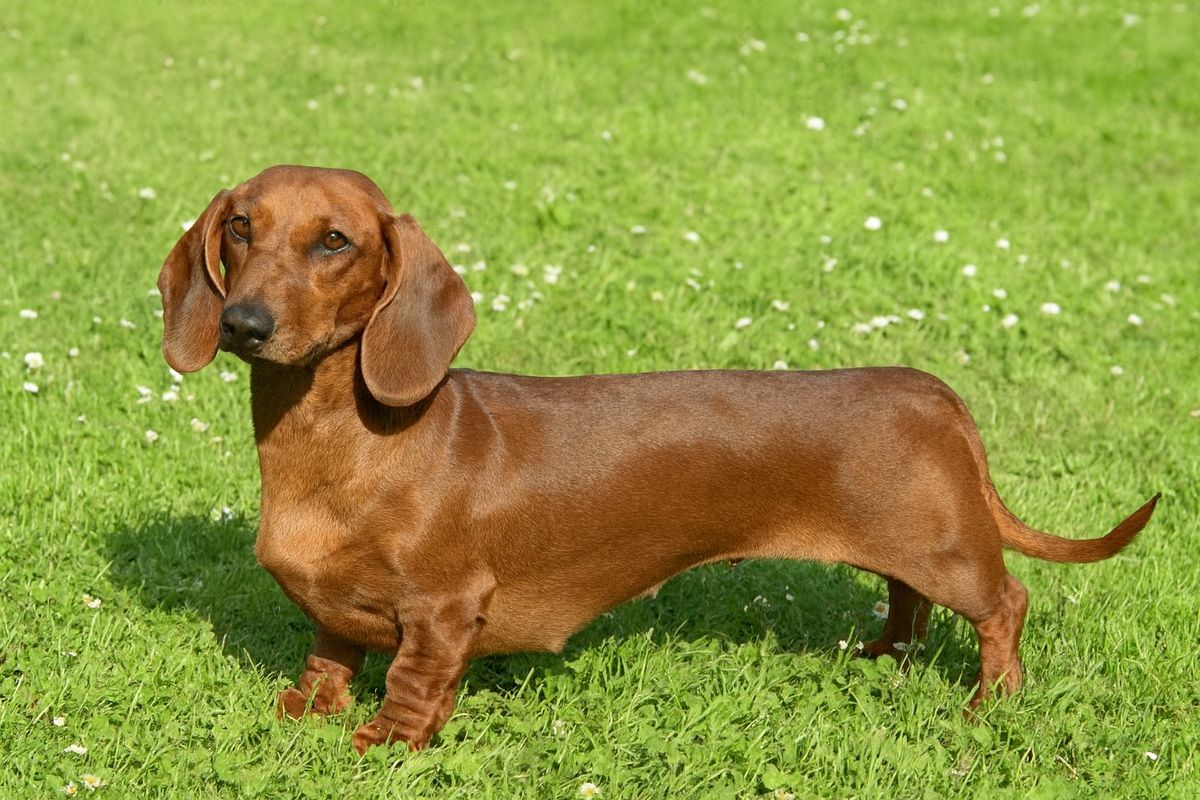
Some dog breeds are particularly susceptible to disc herniations. Particularly affected are short-legged breeds, also known as chondrodystrophic breeds, which are born with abnormal cartilage. These include Dachshunds, Shih Tzus, Lhasa Apsos, and Pekingese. French Bulldogs, Beagles, Poodles, and Cocker Spaniels are also frequently affected by this condition. These breeds share a genetic predisposition that makes them more prone to problems with their intervertebral discs.
What are the signs of a disc herniation ?
The main symptom of a disc herniation in dogs is spinal pain. This pain can manifest in various ways:
- abnormal posture (lowered head, arched back)
- stiffness of the neck
- trembling, shivering, or muscle spasms
- reluctance to move or lift the head
- whining or other vocalizations during movement or manipulation.
A disc herniation in dogs can compress the spinal cord, damaging the nerves and leading to neurological deficits. If the intervertebral disc suddenly slips, bleeding into the spine can also occur, exerting even more pressure on the nerves. This can cause some or all of the following neurological symptoms:
- loss of coordination, ataxia, legs that "drag"
- weakness
- complete or partial paralysis of individual limbs
- lameness
- fecal or urinary incontinence
- loss of sensation in the limbs.
As soon as you notice one or more of these symptoms, you should consult a veterinarian as quickly as possible.
How is a disc herniation diagnosed?
The diagnosis of a disc herniation in dogs is initially based on the clinical examination by the veterinarian, who assesses the symptoms and performs simple tests. However, depending on the severity of the symptoms, further examinations are often necessary to confirm the diagnosis and assess the exact condition:
- Magnetic Resonance Imaging (MRI): This is the most precise method for diagnosing a disc herniation, as it provides detailed images of the spine, nerves, spinal cord, as well as the intervertebral discs and bones. MRIs are usually reserved for specialized clinics.
- X-rays: While these can show some changes caused by the disc herniation, nerves and the spinal cord are not visible on them.
Additional examinations such as blood tests, a lumbar puncture, or a computed tomography (CT scan) may be necessary, depending on the initial results from the veterinarian and the dog's clinical picture.
These tests help to comprehensively assess the condition and plan targeted treatment.
How is a disc herniation treated?
In less severe cases, conservative treatment may be sufficient. In cases of paralysis, however, surgery significantly improves the dog's chances of regaining its ability to walk and becoming pain-free. It also accelerates the healing process and reduces the risk of relapse. The most severe cases, where there is a complete absence of pain sensation in the limbs (i.e., when the dog shows no reaction even to strong pinching of the toes), represent a surgical emergency and have a poor prognosis for full recovery.
The conservative treatment of a disc herniation in dogs consists of the following measures:
- Strict Rest: A strictly adhered rest period of several weeks is crucial for recovery from a disc herniation. Your dog should remain in a confined area and only be taken outside for short, leashed potty breaks. It is important that your dog absolutely does not jump, run, or climb stairs during this time.
- Pain Management: Pain relief is a central aspect of treatment. Pain medication is usually administered orally at home in the form of tablets or liquids, but can be supplemented with stronger pain medication injected by the veterinarian if necessary. In some cases, hospitalization with continuous pain monitoring may even be required.
- Treatment of Urinary Issues: A disc herniation can affect the nerves that control bladder function. If necessary, it may be required to manually empty your dog's bladder. Your veterinarian will show you how to do this yourself.
- Physiotherapy: Targeted physiotherapeutic measures such as exercises to strengthen muscles, massages, stretching exercises, and passive mobilization techniques are designed to improve mobility, relieve pain, and restore muscle and nerve function.
In the case of surgical treatment for a disc herniation, an intervention is performed on the vertebral body to remove the protruding disc portion that is exerting pressure on the spinal cord. The recovery time after such an operation can vary, but it usually lasts several weeks. The success of the operation is highly dependent on the degree of spinal cord damage and, in particular, on whether and for how long the dog had lost pain sensation in its limbs. Generally, the prognosis for most animals is very favorable. Even for paralyzed dogs that have lost pain sensation in their hind legs, there is a greater than fifty percent chance that they will learn to walk again, provided the loss of pain sensation did not last longer than 48 hours. Although surgery is not without risks, it helps to prevent a recurrence of symptoms and their worsening.
After surgery, your veterinarian will likely recommend physiotherapy to strengthen your dog's muscles and improve its mobility. Physiotherapy can significantly contribute to restoring mobility, even if it can be a lengthy process in more severe cases. It can take several months for a dog to regain full motor function. For dogs that cannot walk well immediately and may require a longer rehabilitation period, a stroller can be useful, allowing them to rest during walks.
Prognosis
Recovery after a disc herniation can take several weeks to months. However, with appropriate treatment, patience, and perseverance, most dogs with mild to moderate
Never miss a tip: Set ipet.ch as a preferred source in your Google account so that our veterinary advice and pet care guides appear higher up in your search results. Optional and can be undone at any time.
 Set ipet.ch as a preferred source on Google
Useful information at a glance
What is a disc herniation in dogs?
A disc herniation, also known as a slipped disc, occurs when the soft core of an intervertebral disc protrudes through the surrounding fibrous ring, exerting pressure on the spinal cord or adjacent nerves. This can lead to neurological symptoms or, in severe cases, paralysis.
What symptoms indicate a disc herniation in dogs?
Symptoms of disc herniation include spinal pain, abnormal posture, neck stiffness, trembling, reluctance to move, and neurological deficits such as loss of coordination, weakness, or paralysis. If these symptoms occur, a veterinarian should be consulted immediately.
Which dog breeds are particularly susceptible to disc herniation?
Short-legged breeds, also known as chondrodystrophic breeds, are particularly susceptible. These include Dachshunds, Shih Tzus, Lhasa Apsos, Pekingese, French Bulldogs, Beagles, Poodles, and Cocker Spaniels. These breeds have a genetic predisposition to disc problems.
How is disc herniation treated in dogs?
Treatment can be conservative or surgical. Conservative measures include strict rest, pain management, and physiotherapy. In severe cases with signs of paralysis, surgery may be necessary to improve the chances of recovery.
How can disc herniation be prevented in dogs?
To minimize the risk of disc herniation, your dog should maintain a healthy weight and be exercised regularly but appropriately. Avoid climbing stairs and jumping on furniture. At the first signs of back pain, a veterinarian should be consulted immediately.