
 EN
 DE
 FR
Understanding cat body language
-
 By
med. vet. Bianca Michoud-Valente
- Nov 9, 2026
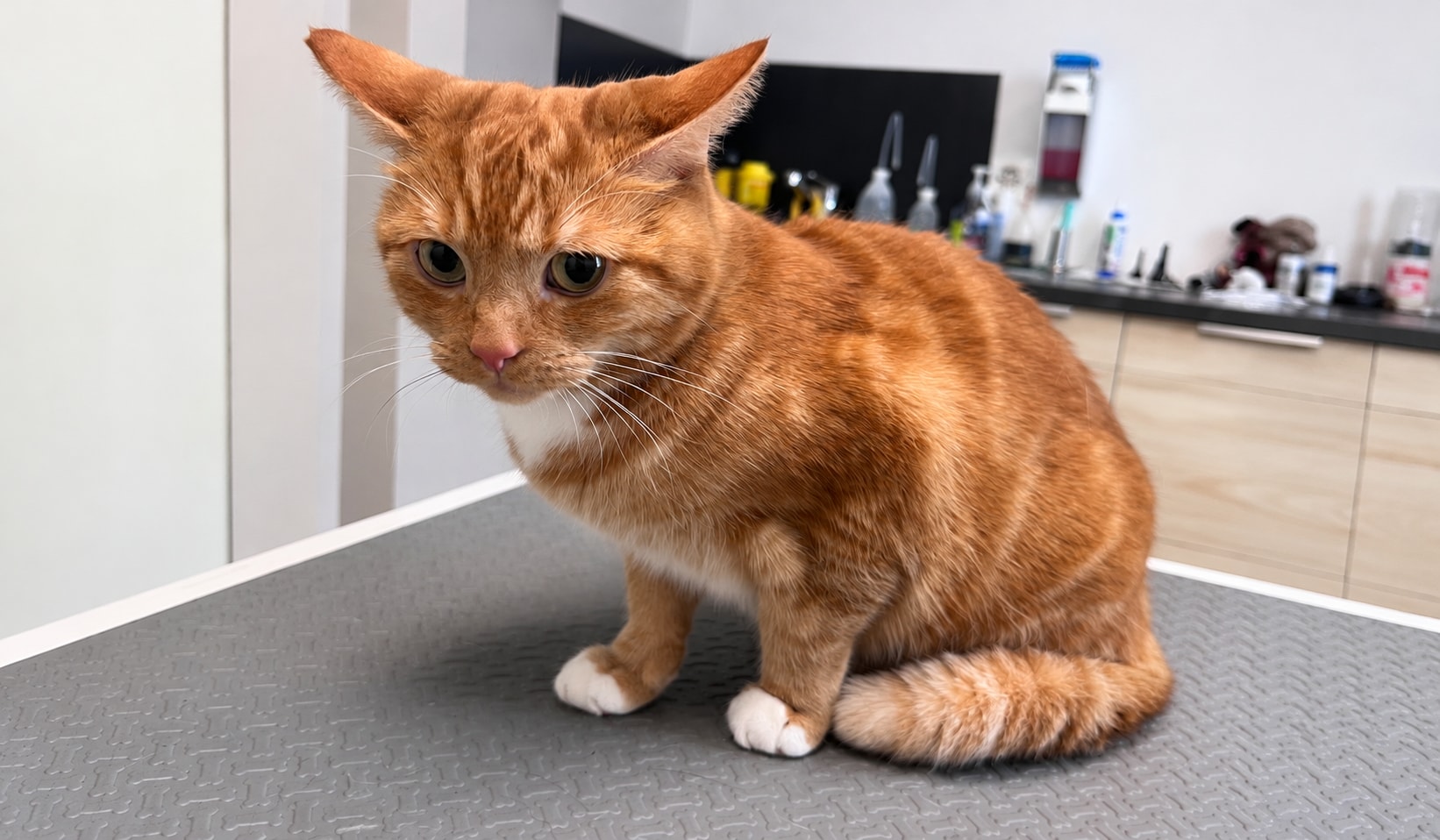
Your cat stares at you from the sofa, its tail twitching. Happy or annoyed? Does your cat swish its tail, flatten its ears or look at you while slowly blinking? Each of these small gestures offers clues to how it feels.
Cats communicate mainly without words: through body postures, facial expressions, scent, physical contact and, less frequently, vocalisations. Learning to read these signals helps you understand their needs, recognise early signs of discomfort, respect their boundaries and live together more harmoniously. It can also help you spot pain or illness.
Five key points
- No single signal tells the whole story: look at the entire body (tail, ears, eyes and posture) and the context.
- A motionless cat is not necessarily calm: it may be frozen with fear.
- A cat that hisses, scratches or bites is not 'nasty': it is protecting itself.
- Purring does not always mean a cat is happy.
- A sudden change in behaviour warrants veterinary advice.
How do cats communicate?
Cats use five forms of communication: body postures, facial expressions, scent, physical contact and vocalisations.
Meowing is mainly directed at people, although mother cats and their kittens also meow to one another. Depending on the situation, it may express a request for attention or food, or signal discomfort.
To understand how your cat feels, observe its whole body and the situation. A tail movement or ear position alone is never enough to interpret an emotion.
How can I tell if my cat is stressed? The six stress levels
The Cat Stress Score (Kessler and Turner, 1997) describes six levels of stress based on a cat's posture and behaviour. Originally developed to assess stress in cats housed in boarding catteries, it also provides useful guidance for recognising signs of discomfort at home.
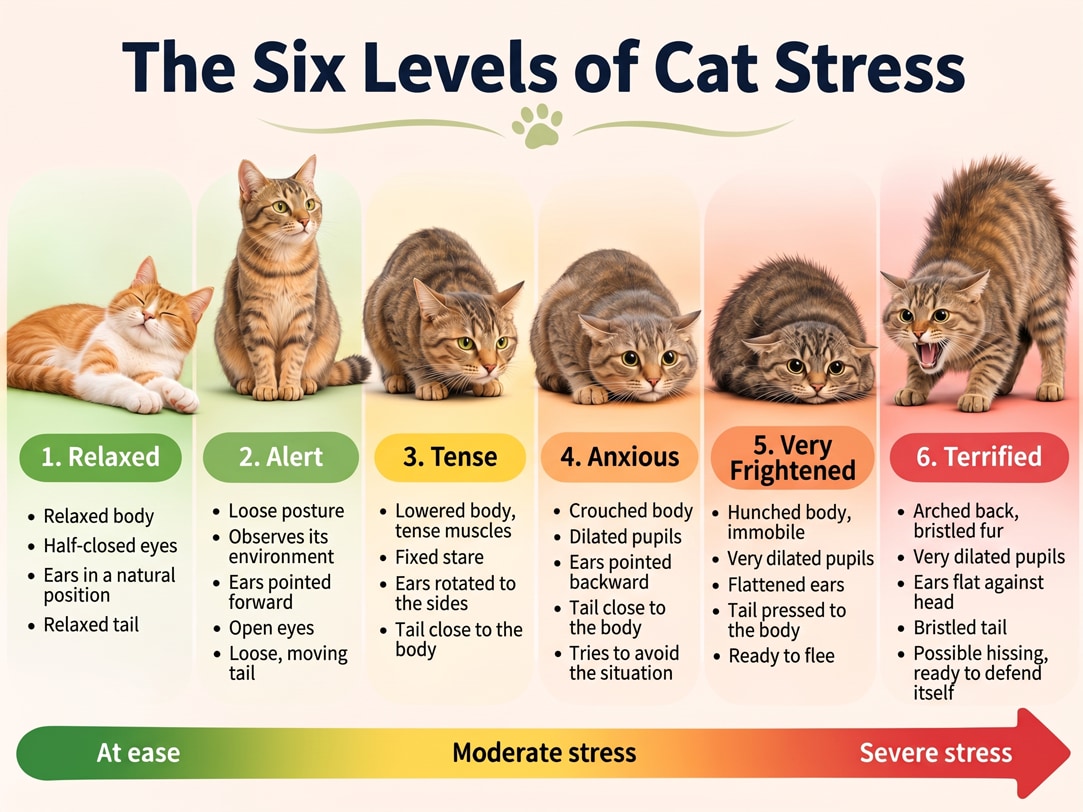
A motionless cat is not necessarily calm: freezing can be a response to intense fear!
At levels 5 and 6, a cat may try to escape or defend itself if approached persistently. Defensive aggression is possible if it feels cornered. Do not try to pick it up, even to reassure it. If the situation continues or handling is necessary (for example, for treatment), ask your veterinarian for advice.
What does my cat's tail mean?
The tail is a useful indicator of mood, provided you consider the rest of the body. Unlike dogs, cats do not necessarily wag their tails when they are happy.
| Tail position | Likely meaning |
|---|---|
| Held upright, sometimes with a slightly curved tip | Friendly greeting, confidence, pleasure at seeing you |
| Shaped like a question mark | Curiosity, willingness to interact |
| Relaxed, carried low or horizontally | Relaxed cat |
| Tip twitching, or tail quivering when held upright | Excitement, sometimes pleasure. It can also accompany scent marking |
| Lashing with broad, rapid movements | Irritation, frustration or conflict. Stop the interaction |
| Puffed up ('bottle-brush tail'), fur standing on end | Fear or strong arousal; the cat is trying to look bigger |
| Held tightly against the body or between the legs | Fear, anxiety or discomfort |
A tail moving slowly and gently while a cat watches something can also indicate concentration, for example before pouncing on a toy. Once again, context makes all the difference.
Ears, eyes and whiskers: reading your cat's face
The face provides valuable clues, especially when several features are considered together.
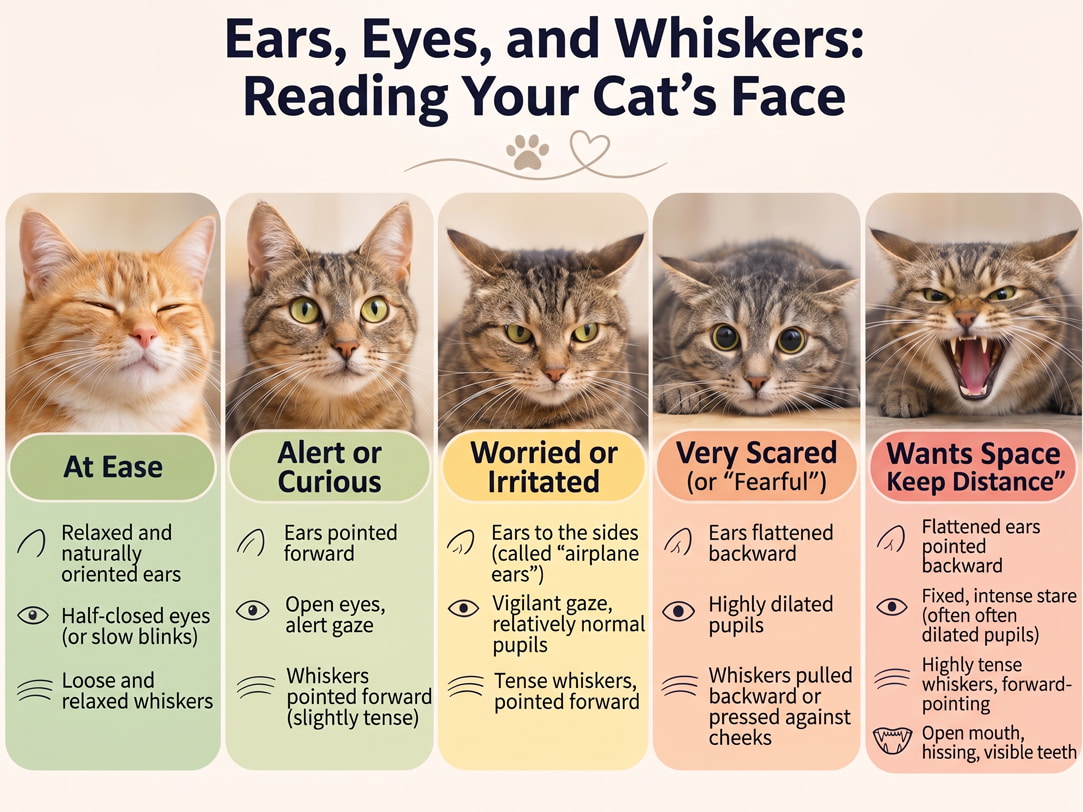
Pupil size also changes with light levels, so always take the lighting in the room into account.
|
Relaxed cat, slowly blinking |
Stressed cat, restless |
Frightened cat, frozen |
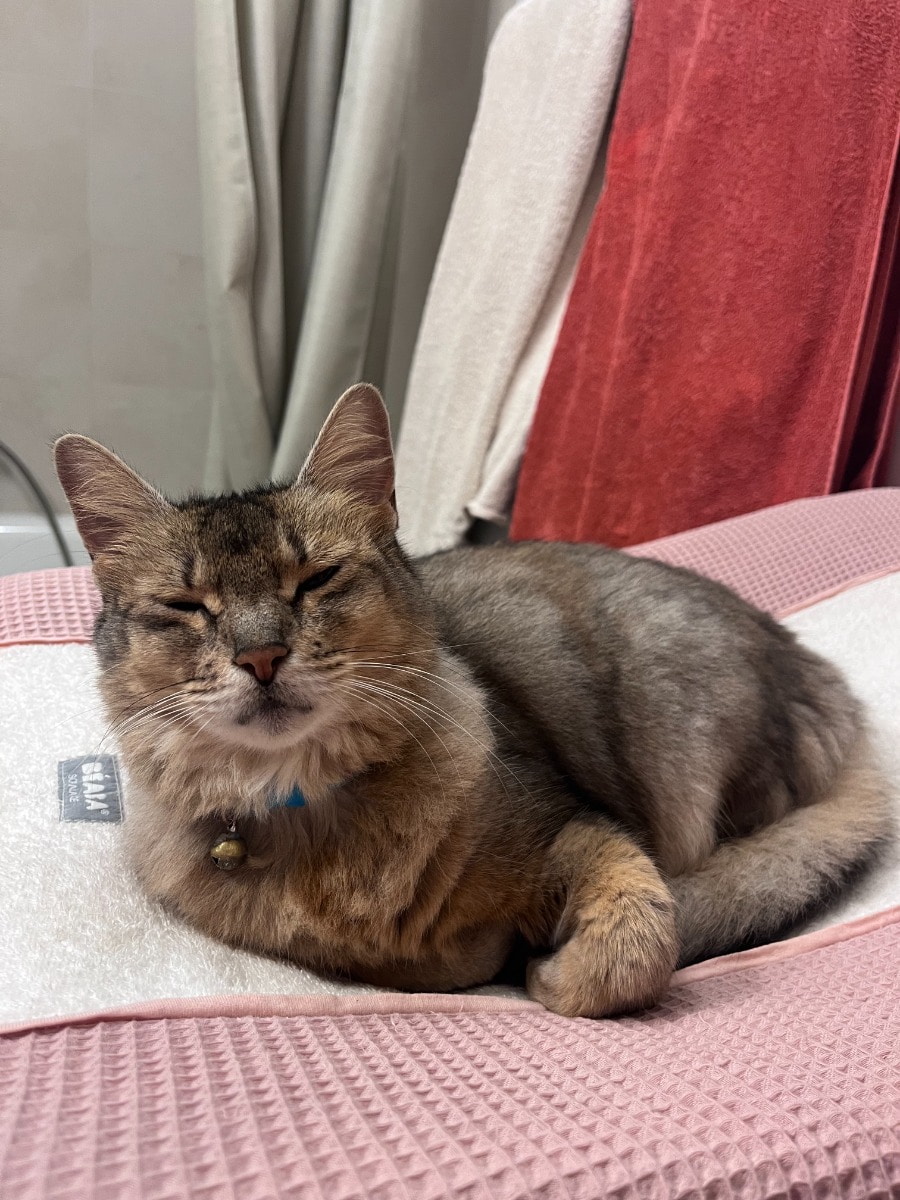
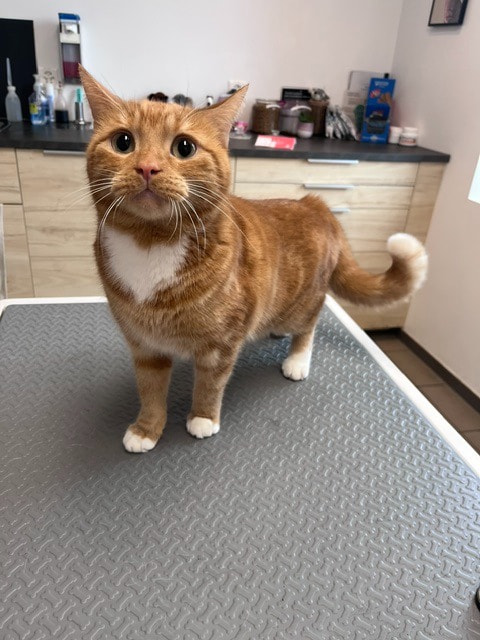
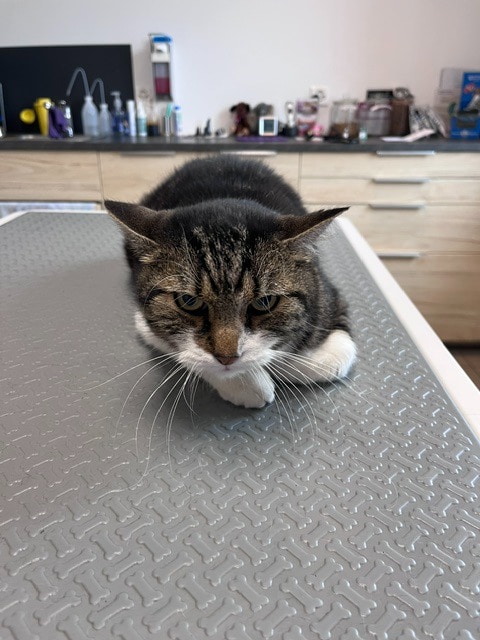
Slow blinking: a cat's 'smile'
When your cat looks at you and slowly blinks, it generally signals relaxation and trust. You can respond by blinking slowly in return without staring: this is a gentle way to communicate with your cat.
Conversely, a prolonged, fixed stare may be perceived as threatening, particularly by a worried or unfamiliar cat.
Meowing, purring and hissing: what is your cat saying?
Vocalisations complement body language but never replace it.
| Sound | Possible meaning |
|---|---|
| Meow | Request for attention, food or access to a room, or a sign of discomfort. Unusually frequent meowing warrants veterinary advice |
| Trill (a short, high-pitched rolling sound) | Friendly greeting, often between a mother and her kittens or directed at a person |
| Purr | Often relaxation and social contact, but not always (see below) |
| Growl, low rumble | Warning: the cat wants to be left alone |
| Hiss, spit | Fear or defence: the cat wants to keep something worrying at a distance |
| Prolonged yowl | Distress, disorientation, pain or conflict. Take it seriously |
Does purring always mean a cat is happy?
No. Cats purr when relaxed, but also when stressed, in pain or unwell. Purring may help them soothe themselves. If your cat purrs while its body is tense, it is hiding or eating less, do not rely on the sound alone: observe its posture and behaviour, and consult your veterinarian if in doubt.
Play or aggression: how can you tell the difference?
Many owners mistake a cat that is playing for one that is defending itself. These clues can help you distinguish the two.
✓ Cat at play
- Body: Relaxed, varied movements, jumps and chases
- Ears: Upright or moving freely
- Claws and teeth: Gentle, inhibited nips; claws usually sheathed
- Voice: Quiet
- Pauses: Takes breaks and switches roles
✗ Cat defending itself or attacking
- Body: Stiff, tense, frozen or crouched
- Ears: Flattened or pinned back
- Claws and teeth: Forceful bites, claws extended
- Voice: Growling, hissing, yowling
- Pauses: Does not stop; tries to drive the threat away or cause injury
Avoid playing with your hands or feet: your cat may learn that targeting them is acceptable and treat them like prey. Use wand toys or toys attached to a string, and stop playing as soon as signs of tension appear.
Why does my cat become aggressive?
A cat is never simply 'mean'. When it scratches, bites or hisses, it is usually expressing discomfort, fear, frustration or a need to protect itself.
In a stressful situation, four responses may occur, often known as the 'four Fs':
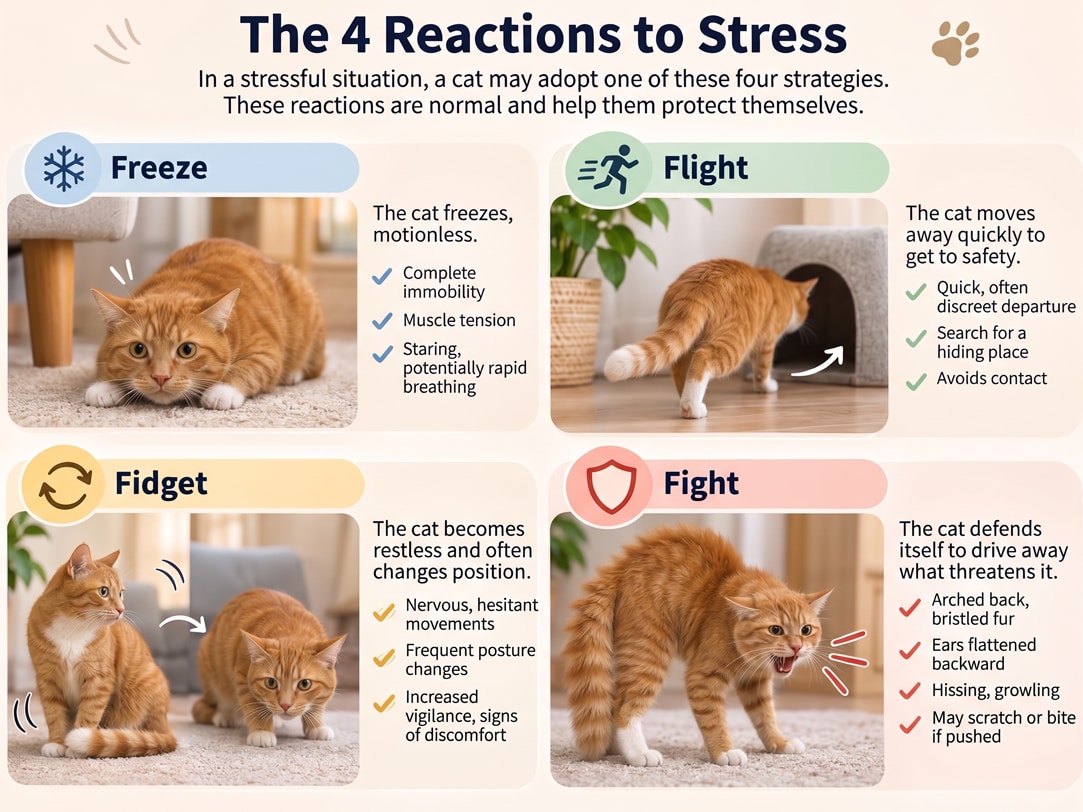
These responses are not mutually exclusive: one may follow another. A cat that initially runs away but then finds itself cornered may switch to defence.
Several factors may explain an aggressive reaction:
- insufficient socialisation during the first weeks of life, which can make some cats more sensitive to handling and unfamiliar situations;
- previous negative experiences;
- pain or illness, especially when aggression is new.
Chronic stress can also lead to withdrawal, reduced activity, excessive grooming or toileting outside the litter tray. These changes require veterinary assessment to rule out an underlying medical cause.
Where does my cat like to be stroked?
Not all cats enjoy physical contact in the same way. Some areas are generally better tolerated than others.
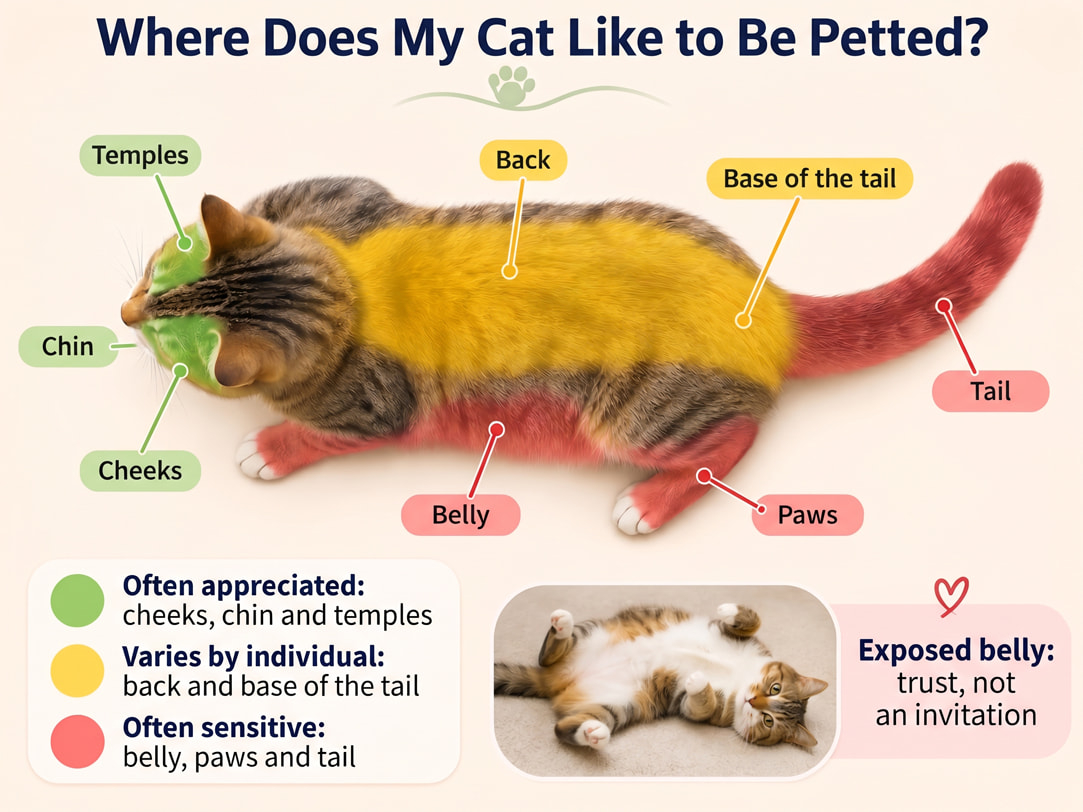
Showing the belly is not an invitation to stroke it!
A cat that rolls onto its back in front of you may be showing trust. But this does not mean it wants its belly stroked: reaching towards it may trigger a defensive reaction.
When petting becomes too much
Some cats enjoy being stroked for a while, then suddenly bite or scratch. This is not bad temper: their tolerance threshold has been reached (sometimes called overstimulation). Warning signs include a lashing tail, ears turning sideways or flattening, moving away, turning the head towards your hand, and a tense body.
Respect your cat's boundaries for a happier home
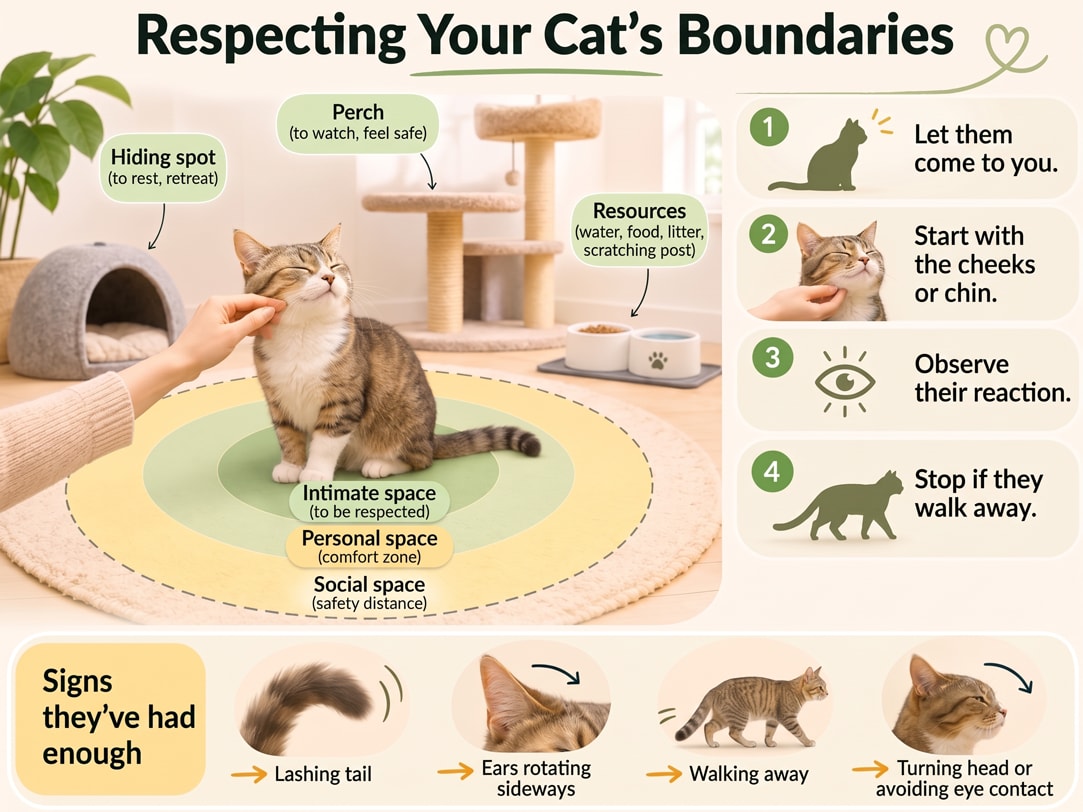
Every cat has its own tolerance threshold for stimulation and restraint. This depends on its temperament, experiences and emotional state. A cat gradually accustomed to handling will generally accept it better than one with unpleasant past experiences. But even a very sociable cat has limits.
To build a trusting relationship:
- respect its rest periods and ability to withdraw;
- provide hiding places, elevated resting spots and enough resources (litter trays, food and water bowls, scratching posts);
- avoid forced interactions and punishment, which increase fear;
- introduce care and handling gradually, using positive experiences;
- teach children to recognise when a cat wants to be left alone.
In summary
Understanding your cat starts with observing it and respecting its signals. A cat that runs away, freezes or defends itself is not being difficult: it is expressing a need or emotion.
By recognising early signs of discomfort and allowing your cat to choose when to interact, you support its wellbeing and strengthen your bond. Any sudden change in behaviour may have a medical cause and warrants veterinary advice.

Add iPet.ch to your preferred sources on Google
Don't miss our advice! Add iPet.ch to your preferred sources in your Google account to find our articles and veterinary advice more easily in search results. It's free, optional and can be changed at any time.
Add to my preferred sources →