EN
EN  DE
DE  FR
FR How to prepare your cat for a baby: a complete guide
-
 By
med. vet. Bianca Michoud-Valente
By
med. vet. Bianca Michoud-Valente - Apr 2, 2026
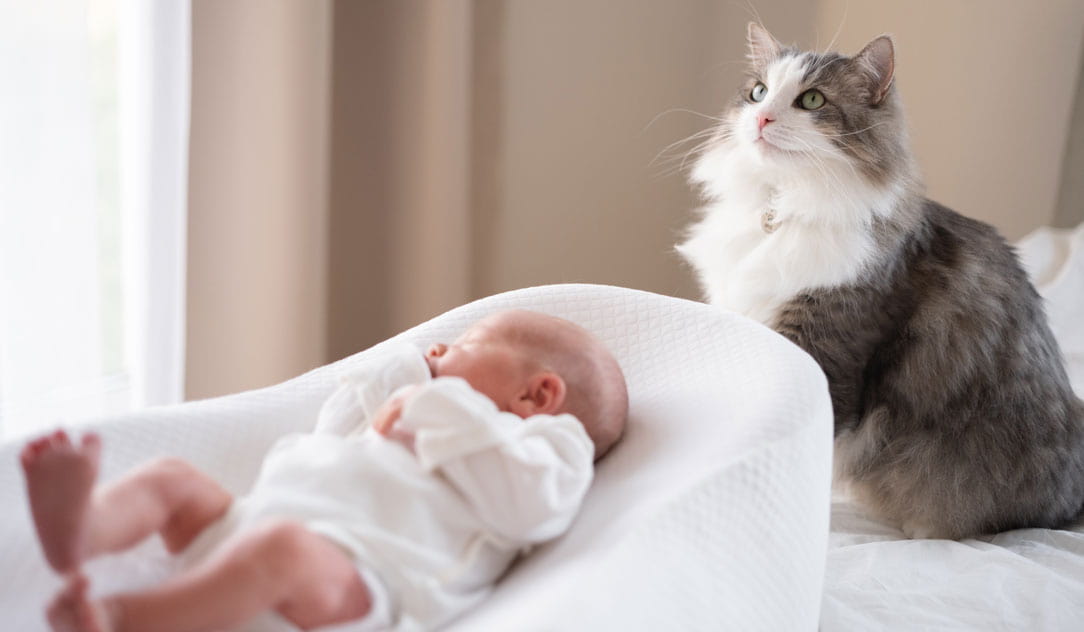
The arrival of a baby is a wonderful moment, but also a major change for the whole family… including your cat! Cats are very attached to their routine and the stability of their environment, and may be sensitive to any sudden changes. This can result in stress or unusual behaviors such as marking, withdrawal, or defensive aggression.
By anticipating these changes and respecting your cat’s pace, it is entirely possible to create a harmonious, safe and positive coexistence between your child and your four-legged companion.
1. Better understand your cat before the baby arrives
The cat is a territorial animal, highly sensitive to its environment, smells and sounds. A predictable setting and stable routines (meals, play, rest) are essential for its well-being.
The arrival of a newborn introduces many new elements: crying, unpredictable movements, unfamiliar smells. If these changes occur suddenly, they can cause discomfort. The goal is therefore to prepare your cat gradually to avoid unnecessary stress.
2. Anticipating environmental changes
Introduce new elements gradually
The earlier you start preparing, the easier it will be for your cat to adapt. Set up the baby’s room and equipment gradually (crib, stroller, changing table…).
Let your cat explore these new elements freely, without forcing or pushing it away, so they become familiar.
Also get your cat used to new smells (baby products, detergents) by introducing them gradually, ideally associated with positive experiences (play, petting, treats).
Managing access to the baby’s room
Decide in advance whether access will be allowed or not, and be consistent.
If access should be restricted, implement this rule before the baby arrives. This prevents the cat from associating the restriction with the baby.
Even if access is allowed under supervision, it is recommended to keep the cat away from the crib, bassinet or bed for safety and hygiene reasons.
Stay consistent: if you want to restrict access, set this rule well before the birth. This way, your cat will not associate the new limitation with the baby’s arrival.
Getting used to new sounds
A baby’s cries can be unsettling. You can play recordings at a low volume, then gradually increase it if your cat remains relaxed. Associate these sounds with something positive (treats, play).
Also introduce sound toys intended for your child gradually to avoid surprise.
Tip: You can play recordings of crying at a low volume, then gradually increase it if your cat remains relaxed. Associate these sounds with something positive (a cuddle, a treat).
✓ Gradual actions
- Set up the baby’s room and equipment gradually (crib, stroller, changing table).
- Let your cat explore these new elements freely without forcing or pushing it away.
- Get your cat used to new smells (baby products, detergents) associated with positive experiences such as play or treats.
✘ To avoid
- Introducing all changes suddenly on the day of birth.
- Forcing contact if the cat shows signs of fear.
- Waiting until the last moment to restrict access to certain areas.
3. Maintaining the routine
Keeping familiar routines is essential to reduce stress:
- Avoid moving the litter box, food bowls or resting areas.
- If a change is necessary, introduce it gradually several weeks before the birth.
- Maintain regular feeding and interaction schedules.
- Provide elevated areas so your cat can retreat while observing its environment.
4. Adjusting attention time
The arrival of a baby naturally reduces available time. To prevent your cat from feeling neglected, anticipate these changes by gradually modifying your habits before the birth.
Maintain a short daily moment with your cat: a few minutes of play, or a longer moment of petting, cuddling or grooming if your cat enjoys it. This helps preserve the bond and reduce stress-related behaviors.
5. Additional support: pheromones and supplements
For sensitive cats, some supportive measures can be helpful.
Calming pheromone diffusers such as Feliway Optimum can help reduce stress related to changes.
Some supplements containing calming active ingredients such as Zylkene Plus or Anxitane can also support adaptation.
These tools are complementary and do not replace proper environmental preparation.
| Type of support | Examples | Benefits |
|---|---|---|
| Pheromone diffusers | Feliway Optimum | Help stabilize the cat’s emotional state. |
| Dietary supplements | Zylkene Plus, others | Support adaptation thanks to calming agents. |
6. Health, hygiene and safety
- Make sure vaccinations and parasite treatments are up to date.
- Regular deworming is important, especially for outdoor cats.
- Good hand hygiene after handling the litter box is essential.
7. What about toxoplasmosis?
Toxoplasmosis is a parasitic disease caused by Toxoplasma gondii, for which the cat is the definitive host. It is often a concern during pregnancy, as a primary infection in a pregnant woman can affect the fetus. However, the risk from a domestic cat is low, especially if it lives indoors and eats commercial food.
The main sources of contamination for pregnant women are raw or undercooked meat and contaminated soil (so be careful with unwashed fruits and vegetables and gardening). Simple measures can reduce the risk when living with a cat: avoid handling the litter (or wear gloves and wash hands thoroughly afterwards), clean the litter box daily, and wash hands after any contact with the cat. Pregnancy and living with a cat are therefore fully compatible with appropriate precautions.
Precautions: Avoid handling the litter (or wear gloves), clean the litter box daily and wash your hands after any contact.
8. The baby’s arrival: first encounters
For the first meeting between your baby and your cat to go well, it should be gradual. Before returning home, you can present your cat with a piece of clothing carrying the baby’s scent. This allows the cat to become familiar with this new smell calmly.
Then, upon arrival, let your cat approach freely, without constraint and at its own pace. Stay calm and reassuring. Cats will often want to approach, observe and sniff the baby when the baby is calm, usually when sleeping.
If your cat prefers to withdraw at first, this is completely normal and should be respected. Never force contact; some cats simply need a few weeks before they are ready to approach.
Respect its pace: Withdrawal behavior is common at first; it is important not to force contact. This can take several weeks. If signs of stress persist (aggression, inappropriate elimination, loss of appetite), consult a veterinarian promptly.
✓ Do
- Give the cat a piece of clothing worn by the baby to sniff beforehand.
- Allow the cat space and opportunities to retreat.
- Stay calm to reassure your cat.
✘ Don’t
- Force contact between the cat and the baby.
- Disturb the cat when it shows signs of stress.
- Introduce sudden changes on the day of returning home.
Safety: Never let the cat sleep with the baby or settle near its face. Interactions must always be supervised.
9. Teaching the child to interact with the cat
As the child grows, it is essential to teach them how to interact with the cat. Teach them not to pull fur, to respect resting times and to recognize warning signs (tail swishing, flattened ears, dilated pupils, growling, retreat, swatting).
Understanding cat body language: a swishing tail, paw swipes, flattened ears, dilated pupils or a slight growl are clear signs that the cat wants to be left alone.
Preparing your cat for the arrival of a baby means anticipating changes, preserving its routines and respecting its pace. With a gradual approach, coexistence becomes a positive experience for the whole family.

Set ipet.ch as a preferred source on Google
Never miss a tip: Set ipet.ch as a preferred source in your Google account so that our veterinary advice and pet care guides appear higher up in your search results. Optional and can be undone at any time.
Set as preferred source →