EN
EN  DE
DE  FR
FR Feeding Cats Correctly - How to Prevent Boredom!
-
 By
Dr. med. vet. Sabina Büttner
By
Dr. med. vet. Sabina Büttner - Mar 15, 2020
For our cats to lead a healthy and happy life, it is important not only to consider the quality of the food but also how it is provided. This article focuses on the feeding technique. How often should a cat be fed, and what is the best way to offer them their food? Find out here.
Hunting and Eating
Even after 5000 years of domestication, cats are still pronounced hunters who spend a lot of time hunting and eating small prey animals. If possible, our cats spend several hours a day engaging in typical hunting behaviors, such as spotting, lurking, stalking, and catching prey. They do this not primarily out of hunger, but because it is species-typical behavior and part of a cat's primal instincts.
The original diet of cats consists of small prey animals, primarily mice and birds, of which they eat 10 – 15 pieces throughout the day. However, captured and killed animals are not always eaten, especially by our fed domestic cats, but sometimes left behind or brought home to humans as a 'gift'.
Common Feeding Methods
Rationed Feeding
Often, cats are only given food two to three times a day. This does not meet the needs of cats, who prefer to eat small food portions repeatedly throughout the day. Cats often have great hunger during these meals and therefore tend to gobble down their food, which can lead to them vomiting it up shortly after. During times when no food is available, cats often suffer from boredom and, because the intervals between meals are too long, also from hunger.
Food Available Freely
Another common feeding method is constant, free access to food. The bowl with dry food is constantly filled, and the cat can help themselves whenever they are hungry. This type of feeding thus meets the cats' need for many small meals distributed throughout the day. For outdoor cats who can live out their species-typical hunting and eating behavior outside, this can certainly be a suitable feeding practice.
However, for purely indoor cats or cats with a tendency to be overweight, this type of feeding can lead to problems. It does not satisfy the cats' hunting instinct and can lead to cats eating too much and becoming overweight.
| Method | Description |
|---|---|
| Rationed Feeding | Often, cats are fed only 2 to 3 times a day. This does not meet the cat's natural needs and can lead to gulping their food (resulting in vomiting) or boredom between meals. |
| Food Available Freely | The bowl is always filled with dry food. While this suits active outdoor cats, it can lead to obesity in indoor cats because it does not satisfy their hunting instinct. |
How to Feed Cats Correctly
✅ Do's
- Offer food throughout the day.
- Use food-dispensing toys.
- Regularly change the location of the toys.
- Combine feeding with play and training (e.g., clicker training).
✘ Don'ts
- Limit your cat to only two fixed meals a day.
- Leave toys in the same spot for too long.
- Only serve food in a "passive" bowl.
On the one hand, food should be offered throughout the day; on the other hand, especially indoor cats should also be able to live out their play and hunting instincts in connection with feeding.
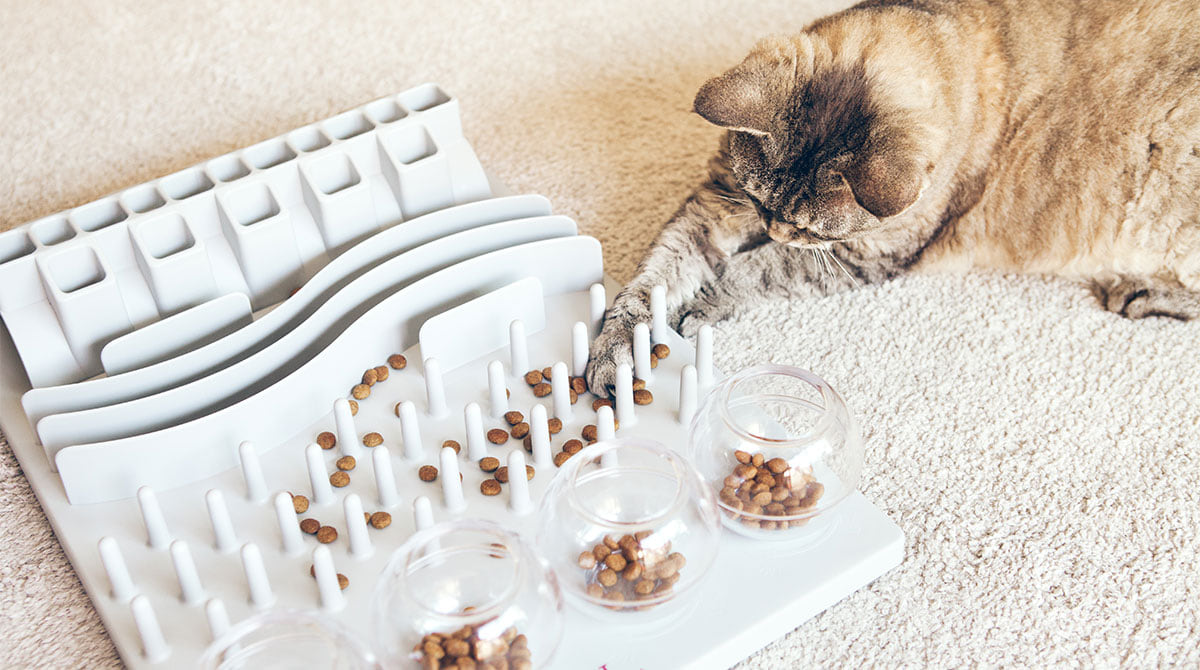
For this purpose, special food toys are suitable, which are placed alternately in several locations in the home. They ensure that the cat is occupied with food intake for longer and, depending on the toy, also moves more.
Suitable food toys include food puzzles, which are available in different difficulty levels, as well as food balls, puzzle feeders, or snuffle mats. It's best to get different types of toys and place them in various locations in the home, and the toys should also be rotated regularly so that boredom doesn't set in permanently.
There should always be a food-filled toy somewhere in the home throughout the day. However, there are cats who empty all toys in the shortest possible time. For such cats, the toys should be refilled up to five times a day, if possible.
Some food toys can also be filled with wet food. This is especially useful for cats who exclusively eat wet food. For all others, we recommend offering dry food in the toy and wet food still once or twice a day in the bowl.
Practical Tip: Combine dry food in a toy with wet food meals in a bowl.
Of course, you can also combine feeding your cat with shared play and training. Treats can be hidden, thrown, or placed in a rummage box (cardboard box with newspaper). Many cats also love to learn little tricks with the help of a clicker and a tasty food reward. Therefore, plan regular short training sessions. This not only keeps the cat occupied but also strengthens the bond between human and cat.
Conclusion: Species-appropriate feeding means incorporating the natural needs for hunting and mental stimulation into the cat’s daily routine.
Source: Information sheet 'Species-Appropriate Cat Feeding'; Swiss Veterinary Association for Behavioral Medicine

Set ipet.ch as a preferred source on Google
Never miss a tip: Set ipet.ch as a preferred source in your Google account so that our veterinary advice and pet care guides appear higher up in your search results. Optional and can be undone at any time.
Set as preferred source →Useful information at a glance
How often should my cat be fed per day?
Cats should receive several small meals distributed throughout the day. This corresponds to their natural behavior, as they would hunt and eat many small prey animals in the wild. Approximately 10 to 15 small portions per day are ideal.
Is it better to offer my cat free access to food?
Offering food with free access can be suitable for outdoor cats, as they can satisfy their hunting instinct outside. However, for indoor cats or cats prone to obesity, this can lead to problems, as it does not satisfy their hunting instinct and can lead to obesity.
How can I account for my indoor cat's hunting instinct during feeding?
Use feeding toys such as food puzzles, food balls, or snuffle mats to encourage your cat's hunting instinct. These toys ensure that the cat is engaged longer with food intake and moves more. Change the toys regularly to prevent boredom.
Can I use wet food in feeding toys?
Yes, some feeding toys can also be filled with wet food. This is particularly useful for cats that exclusively eat wet food. For other cats, we recommend offering dry food in toys and wet food once or twice daily in a bowl.
How can I combine feeding with play and training?
You can hide treats, throw them, or place them in a rummage box. Many cats also love to learn small tricks with the help of a clicker and a fine food reward. Schedule regular short training sessions to keep the cat engaged and strengthen the bond.