
 EN
EN  DE
DE  FR
FR How Dogs and Cats See the World
-
 By
Dr. med. vet. Sabina Büttner
By
Dr. med. vet. Sabina Büttner - Aug 21, 2019
Humans perceive the environment primarily through their eyes. But how do our dogs and cats actually see the world? Various parameters play an important role here, which we will briefly discuss below.
Less Colorful
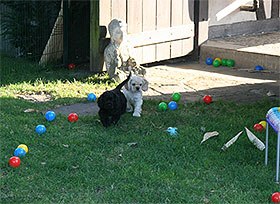
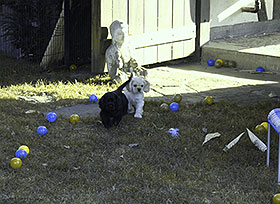
Which colors a living being can recognize depends on the type of photoreceptor cells present on the retina in the eye. In the human retina, the so-called cones dominate. There are various types of these, each responding only to specific wavelengths of light and thus important for distinguishing colors. Humans have three different types of cones, whereas dogs and cats only have two types. Therefore, they do not see the same color spectrum, but essentially have red-green color blindness. The world is therefore likely to appear blue-grey-yellow to them.
| This is how humans see it: | This is how dogs and cats see it: |
 |
 |
Much Better in the Dark
Another type of photoreceptor cells, the so-called rods, are much more light-sensitive than cones. They are responsible for seeing something even in low light. However, colors cannot be distinguished with them. These light-sensitive rods dominate in the retina of dogs and cats. Additionally, a reflective layer at the back of the eye ensures that incoming light is optimally utilized. Cats and dogs therefore see almost as well at dusk and at night as they do during the day.
Blurry
Visual acuity refers to the ability to distinguish individual objects from one another. It depends on various anatomical conditions in the eye, such as the number of photoreceptor and optic nerve cells, or the shape and mobility of the lens. In general, it can be said that dogs and cats have a much lower ability to see sharply than humans. Anything further than approx. six meters away, they can no longer focus on particularly well. Dogs also have an extremely limited ability to focus up close: objects that are closer than 30 to 50 cm cannot therefore be seen sharply by them.
From a Different Perspective
It is often forgotten that the perception of the environment is very strongly determined by perspective. This means: The distance of the observer's eyes from the ground is very crucial for what they see.
| This is what a cat sees: | This is what a medium-sized dog sees: |
This is what a human sees: |
 |
 |
 |
Compared to human vision, the eyesight of dogs and cats is therefore significantly reduced in terms of color vision and visual acuity. However, they see much better in poor light conditions. In addition, other senses – such as smell and hearing – play a major role in their perception of the environment and are accordingly much more highly developed.

Set ipet.ch as a preferred source on Google
Never miss a tip: Set ipet.ch as a preferred source in your Google account so that our veterinary advice and pet care guides appear higher up in your search results. Optional and can be undone at any time.
Set as preferred source →Useful information at a glance
What colors can dogs and cats see?
Dogs and cats have two types of cones in their retina, which means they have red-green color blindness. The world appears to them mainly in shades of blue, gray, and yellow.
How well do dogs and cats see in the dark?
Thanks to the light-sensitive rods in their retina and a reflective layer at the back of the eye, dogs and cats can see almost as well in twilight and at night as they do during the day.
How sharp is the vision of dogs and cats?
Dogs and cats have lower visual acuity than humans. They cannot focus well on anything further than six meters away. Dogs also have difficulty seeing nearby objects sharply.
Why is the perspective different for dogs and cats than for humans?
The perception of the environment is strongly determined by perspective, i.e., the distance of the eyes from the ground. This influences what dogs and cats see, as they are closer to the ground than humans.
What other senses are important for dogs and cats?
Besides sight, smell and hearing play a major role in the perception of the environment for dogs and cats. These senses are significantly more developed in them than in humans.