
 EN
EN  DE
DE  FR
FR Secure Dog Transport
-
 By
Dr. med. vet. Sabina Büttner
By
Dr. med. vet. Sabina Büttner - Jun 23, 2021
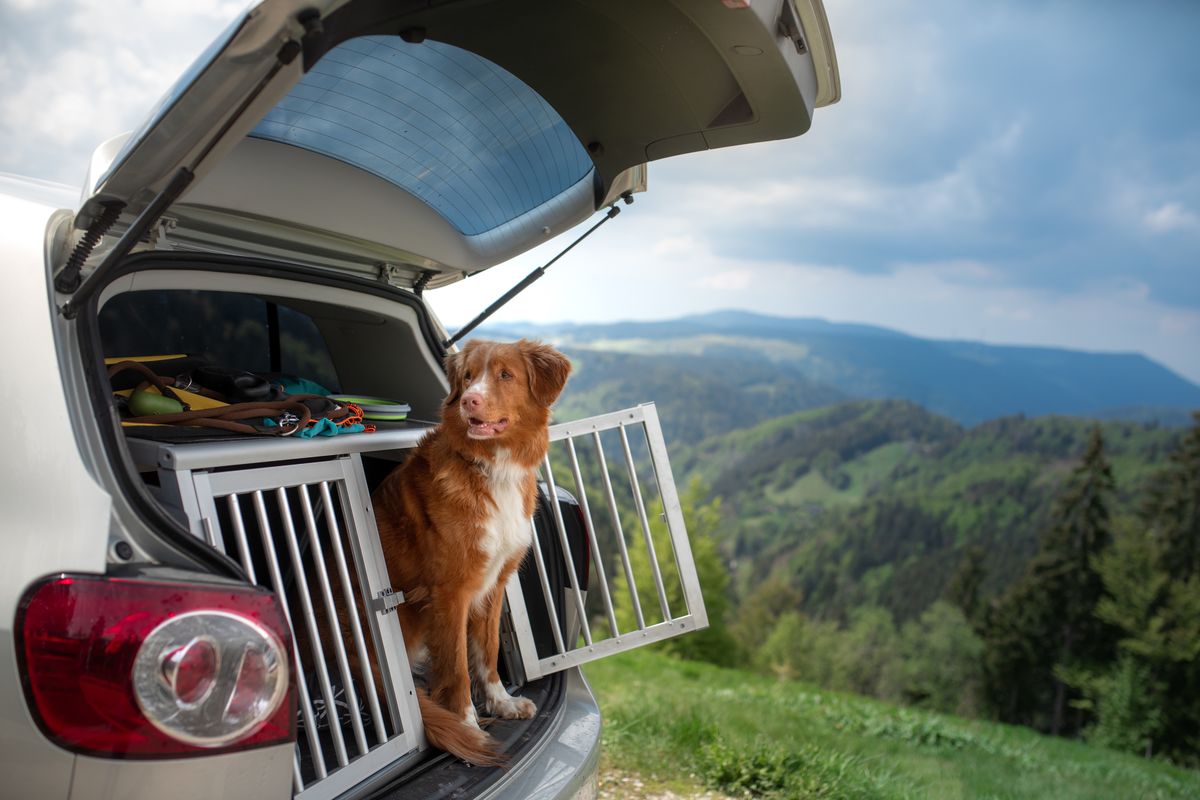
The holiday season is approaching, and many dog owners don't want to go on vacation without their pet. To ensure dogs are safely accommodated in the car or camper, some precautions are necessary.
Are dogs allowed to be transported unsecured in a car or camper?
There are no specific legal regulations for transporting dogs in a car or camper. However, the Road Traffic Act applies, which stipulates that cargo (including dogs) must be transported in such a way that it does not endanger or annoy anyone and cannot fall off. Furthermore, the provisions of animal welfare law apply. Accordingly, all animals must have sufficient space during transport and be transported in a way that they experience neither suffering nor harm.
Transporting a dog freely in the car is therefore not permitted. Firstly, there is a high risk that the dog will distract the driver, preventing them from fully concentrating on traffic. Secondly, the risk of injury for the dog and vehicle occupants in an accident is very high. Even at low speeds, enormous forces develop, causing an unsecured animal to be thrown through the vehicle like a projectile, potentially severely injuring itself and its fellow passengers.
However, the law does not prescribe how animals are to be secured. Here, we briefly explain the Benefits and drawbacks of the most important restraint systems for dogs in cars and campers.
Safety harnesses, car seats, and blankets
Special safety harnesses, which allow dogs to be easily attached to existing seat belt fixtures, are only conditionally recommended. It is important that the chest harness is the correct size and well cushioned. Standard walking harnesses are not suitable, as they usually tear apart in an impact. Collars are also completely unsuitable, as they can cause injuries to the neck area even during sharp braking. The attachment strap must not be too long, so that the dog cannot jump off the seat. However, it must also not be too short, to allow sufficient freedom of movement. The protection offered by such safety harnesses in accidents is rated as deficient by the TCS. Furthermore, they offer dogs little stability during the journey, so they can fall off the seat even with light braking maneuvers. It is therefore advisable to combine such safety harnesses with car seats and car blankets. Car blankets can be installed on the back seat, and car seats can also be mounted on the front passenger seat. They have the additional Benefit of protecting the seat upholstery from dirt.
- Cost-effective
- Space-saving
- Easy to install
- Not a very safe solution
- Too much or too little freedom of movement
- No impact protection in accidents
Dividing grilles and nets
Especially for large dogs transported in the boot of an estate car, dividing grilles or nets are an option. These are easy to install and usually offer sufficient protection so that the dog is not thrown forward in an accident. However, it can still be severely injured as there is no cushioning. Furthermore, such dividing grilles and nets allow dogs a lot of space, so they can lose their balance during braking maneuvers or in tight turns.
- Cost-effective
- Space-saving
- Easy to install
- Not a very safe solution
- Too much freedom of movement
- No impact protection in accidents
Mobile kennels
Mobile kennels offer the safest transport option. For small dogs, small, mobile boxes are suitable. They should be placed in the front passenger footwell or in the footwell behind the front seats. There are also special small car boxes that can be placed on the front passenger or back seat with the seat belts.
Larger dogs are most safely transported in a box in the boot. Foldable boxes and wire crates have the Benefit that they are lightweight and can be stored in a space-saving manner when not in use. In terms of safety, however, sturdy metal boxes are clearly the favorites. They should be placed directly behind the back seat and secured with special straps so that they do not slide around during the journey. This applies especially to lighter models. If they are additionally cushioned with a crash bag, the dog is optimally protected from injuries in an accident.
In a camper, a sturdy mobile kennel is also the safest accommodation for the pet. Here too, the box must be well secured so that it does not slip during the journey or get thrown through the vehicle in an accident. Even better are specially equipped motorhomes where the Crate is already built into the interior.
- Medium to high costs, depending on the size and quality of the box
- Crates are often very bulky
- Offer some freedom of movement for the dog
- Offer great safety
How big should a mobile kennel be?
Determining the correct size of a mobile kennel is extremely important. On the one hand, it must be adapted to the dog, allowing it to sit and lie comfortably. On the other hand, the box should not be too large, so that the dog does not tumble around in it during the journey.
The following guidelines apply to determining the correct box size:
Measure your dog: height from the ground to the tips of the ears (A), length of the front legs (B), length from the tip of the nose to the end of the tail (C), chest width from shoulder joint to shoulder joint (D).
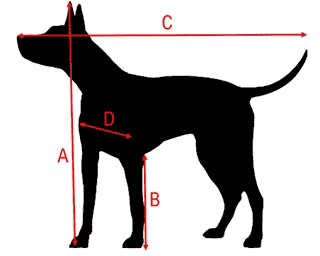
- Crate length: Length (C) plus half of leg length (B)
- Crate width: at least 2x width (D)
- Crate height: Height (A) plus 5 cm
In addition to the dog's size, the available space in the boot naturally also plays an important role. Precise measurement is a must here! Some Crate manufacturers offer practical tools for determining the correct Crate size for dog and car. We are also happy to advise you on this. However, we cannot guarantee that the box will actually fit into the car. If in doubt, it is therefore better to buy the box not online but from a specialist retailer, so that you can test whether the box actually fits into the car and the dog has enough space in it.
We wish you and your dog a pleasant and, above all, accident-free journey for your holidays!
Further information: TCS Test Report 2018: Dog mobile kennels

Set ipet.ch as a preferred source on Google
Never miss a tip: Set ipet.ch as a preferred source in your Google account so that our veterinary advice and pet care guides appear higher up in your search results. Optional and can be undone at any time.
Set as preferred source →Useful information at a glance
Are dogs allowed to be transported unsecured in a car or camper?
No, dogs are not allowed to be transported unsecured in a car or camper. Road traffic law requires that cargo, which includes dogs, be transported in such a way that it endangers or bothers no one. Furthermore, animal welfare regulations must be observed, which stipulate that animals must have sufficient space and be transported in a way that they experience neither suffering nor harm.
Which restraint systems are suitable for transporting dogs in the car?
There are various restraint systems for transporting dogs in the car, including safety harnesses, car seats and covers, divider grilles and nets, and mobile kennels. Mobile kennels offer the greatest safety, especially stable metal boxes, which should be well secured. Safety harnesses and divider grilles offer less protection and should be used with caution.
How do I determine the correct size of a mobile kennel for my dog?
The correct size of a mobile kennel is important so that the dog can sit and lie comfortably, but does not have too much space to slide around during the journey. Measure the height from the floor to the ear tips, the length of the front legs, the length from the tip of the nose to the end of the tail, and the chest width. Use these measurements to determine the length, width, and height of the box. Also consider the available space in the car.
Are safety harnesses a safe option for dog transport?
Safety harnesses offer only limited protection during dog transport. They should be the correct size and well cushioned. Standard walking harnesses are not suitable. Protection in accidents is considered deficient, as they offer little stability and the dog can fall from the seat during braking maneuvers. A combination with car seats or covers can be useful.
What do I need to consider when transporting my dog in a camper?
In a camper, a stable mobile kennel is the safest accommodation for the dog. The box must be well secured so that it does not slip or get thrown through the vehicle in an accident. Even better are specially equipped motorhomes where the dog mobile kennel is already built-in. Make sure the box offers enough space, but is not too large, so that the dog does not slide around.